The Human Curriculum No. 5: When We Cease to Understand the World
On the strange leap from one model of reality into another and how disorienting it can feel
“The fact that I can see music, I think is my advantage.”
Years ago, I saw an MTV2 interview of Kanye West that is permanently ingrained in my memory. Kanye is standing beside a landscape painting he made in high school. He casually pans across it while beatboxing the specific sounds he hears in each object. Each object, a different sound — together, a fluid beat that somehow mirrors the fluidity of the landscape itself.
He finishes and quickly glances over to his family on the right.
“You see it! Can y’all see that? Kind of…?”

Blank stares back, mostly.
Kanye’s making a connection between two different models of the world: image and sound. The landscape isn’t music, but by bringing one representation to another, he can see something in the painting that everyone else in the room cannot.
In the fifth installment of The Human Curriculum, I want to explore this capacity: to go beyond reasoning with models we already have, notice when those models are insufficient, remain inside that mismatch, and find another way of making reality legible again.
No. 5: When We Cease to Understand the World
Benjamín Labatut / 2020 / The Future
Benjamín Labatut’s When We Cease to Understand the World is about the scientists and thinkers who pushed towards deeper truths in physics and mathematics, only to find that each breakthrough made reality harder to grasp. I picked up this book after hearing it as a recommendation from a podcast I listen to regularly.
The Central Argument
Labatut’s book dizzyingly blends fact with fiction. He takes real scientists and breakthrough discoveries, and spins them into imagined, detailed tales about their lives as they pursue the ultimate quest to understand the reality of the world.
He begins with Fritz Haber, whose work on synthesizing ammonia helped make modern agriculture possible, while also accelerating chemical warfare with chlorine gas during World War I. He follows Karl Schwarzschild as he calculates the first solution to the Einstein field equations of general relativity from the Eastern Front. He then enters the mysterious new world of quantum mechanics with Werner Heisenberg and Erwin Schrödinger. Finally, he turns to Alexander Grothendieck, whose pursuit of ever-greater mathematical abstraction eventually led him to withdraw from much of the world around him.
As you get deeper into this book, Labatut leans increasingly into fiction, which makes it harder to tell which parts of the story are real and which are invented. The scientists themselves move toward the edge of what can be understood, and your own sense of disorientation rises in parallel.
When I first finished the book, my immediate interpretation was about the fine line between genius and madness, and how the pursuit of great discovery often blurs that line. But beyond that, I found myself thinking about what each of these people were actually pursuing.
How could someone like Grothendieck obsess over a math equation to the point that he gave up everything to live the rest of his life in anonymity in a French village? What was he looking for? What did he see?
In some sense, all these thinkers were trying to see something in the world that the existing way of seeing it could no longer reveal. They were on the ultimate quest to understand the universe with a new lens.
We tend to imagine understanding as cumulative: as if the more we discover, the clearer the world should become. But at the frontier, the opposite is often true. A model of reality can reveal more and more about the world until it encounters something it can no longer hold. The old model begins to break down before a new one can exist to take its place.
To understand the world differently, we may first have to cease understanding it at all.
What is a model of reality?
Every field of human knowledge is, in some sense, an attempt to make the world graspable. Physics tries to model matter, motion, space, and time in ways that we can test against observation. Mathematics gives us a formal language for relationships and structure that we observe in nature. Language lets us turn the human experience into symbols that we attach meaning to. Music gives form to what we feel through rhythm, harmony, and sound. Art transforms what we perceive through image, metaphor, and composition.
Admittedly, these are not all the same kind of model. Physics and math aim at prediction and precision in an objective view of the world, while language, music, and art help us capture how we feel our way through the subjective world. But each gives us a handle on some part of reality that would otherwise be difficult to hold.
A model acts as a simplifying mechanism on reality. It compresses an infinitely rich world by highlighting certain things and leaving others out. When we search for the right words to describe the joyful tension of first becoming a parent; the right music notes to capture the gentle harmony of birds stirring in the early morning; the right equations to predict what speed a rocket reentering Earth’s atmosphere needs to land safely — we are searching for perfection but we always fall short. That is the nature of reality: no model is perfect in capturing the essence of the Thing. Compression is lossy.
When a model reaches its limit
When We Cease to Understand the World is full of moments when reality begins to exceed the model available for understanding it.
The scientists in Labatut’s book repeatedly arrive at the edge of an inherited framework when they encounter something that no longer fits. The more closely they examine gravity, light, matter, or math — the stranger their existing models begin to look.
Sometimes this mismatch appears as a contradiction: reality appears to behave in a way that the existing model cannot reconcile. Other times, it appears as an excess: the model still works but is insufficient in fully expressing the richness of what’s in front of us.
Heisenberg’s pursuit of quantum mechanics is an example of contradiction. Classical physics pictured nature as objects with definite properties moving along definite paths. But he was more interested in pushing past this frame to see a world where the world existed in probabilities, at an atomic scale. This required a different way of representing physical reality altogether.
Kanye’s interview is a smaller and playful example of excess. A landscape seen only as an image is technically accurate, but he perceives something more in it. To him, mountains, flowing water, and movement become rhythm and sound. By bringing the model of music to something visual, he makes a structure in the landscape newly legible.
In both cases, they encounter a mismatch between the thing in front of them and the models available for understanding. Instead of immediately dismissing the mismatch, they stay with it and find a new way to make sense of their world.
That seems like a subtle but consequential kind of intelligence: recognizing that the problem might be the model itself. It also helps explain why true discovery often borders on obsession and madness. To loosen your grip on an existing model is to surrender some amount of coherence. The old framework no longer feels sufficient, but the new one is not clear yet and the person at the frontier is stuck in between for some period of time.
That can be exhilarating, but also lonely and destabilizing.
What does this mean for AI?
This brings me to the question I keep circling: if some discoveries begin when our models fail, what does that mean for systems built on our models?
Language is already a model of reality. We take our experiences of the world and compress them into words, symbols, descriptions, theories, and equations that give us shared understanding. And large language models (LLMs) are another layer trained on top of those representations, a model built on top of models — learning patterns across the ways that humans have already made reality legible.
A recent paper LLMs Can’t Jump offers one perspective on what we’ve lost along the way. The author distinguishes between induction (finding patterns), deduction (reasoning from existing premises), and abduction (introducing a new explanation when existing ones are insufficient).
The paper asserts that LLMs are not good at abduction.
“While LLMs excel at Induction (finding patterns in data), they lack the sensory agency required to ground these symbols in physical reality. They operate as high-dimensional ”Chinese Rooms” (Harnad, 1990), manipulating the language of physics without access to the physical referents that give that language meaning. This limitation prevents the AI from making the Abductive Jump (E → A). While Einstein could ground his axioms in the physical experience of a falling body, an LLM is confined to the logical deduction of existing texts.”
It motivates the intuition by using Einstein as a grounding example. Einstein imagined what it would feel like to be inside an elevator falling toward Earth. And that imagined physical experience helped him arrive at a new set of principles, which he could then use math to develop and test. His free-fall thought experiment was an imagined encounter with the physical world that made the old model of gravity feel inadequate. So his leap had to come before deduction, he decided which new assumption was worth making before math could tell him what followed from it.
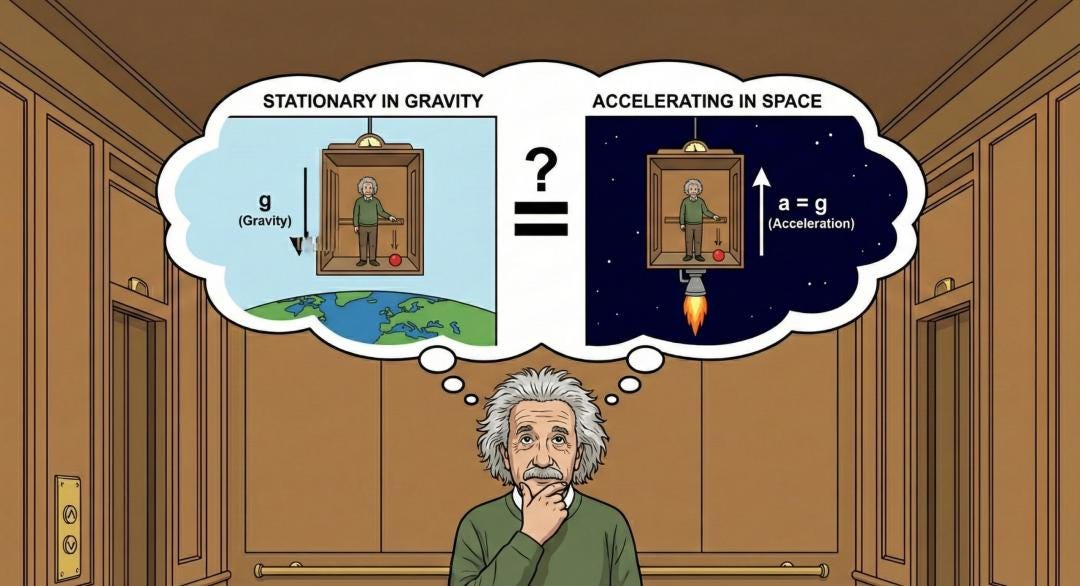
At the edge of a model of reality, the problem may no longer be that you haven’t reasoned hard enough from the premises you already have. It might be a question of subverting the premise.
But AI is already discovering new things
For a while, I thought this gave me a clean way to understand the difference. Humans can recognize when a model has reached its limit and leap into another one. LLMs reason within the representations we have already given them.
But then I had to confront what AI systems are already doing. The reality is that there are new headlines every day about frontier AI models getting smarter and smarter — breaking new ground in science and math, pushing humanity beyond what the smartest scientists and mathematicians could only dream of doing.
Anthropic recently reported that one of its research systems improved a longstanding result related to the Riemann Hypothesis. Though it didn’t go as far as proving the hypothesis, it pushed the result further than any previous human effort (raising the lower bound of Riemann zeta function’s nontrivial zeros from 41.6% to 67.2%).
OpenAI reported that an internal model had disproved a longstanding conjecture in discrete geometry. The model found an infinite family of point constructions that improved on what mathematicians had long believed was essentially optimal for the unit-distance problem. It brought sophisticated ideas from algebraic number theory into an elementary geometric problem.
These are genuine contributions to the frontier of mathematics that push us to reconsider what these machines are capable of achieving.
Reasoning models and agentic loops are changing what it means for a model to “think”. Even if a model’s weights are fixed after deployment, we’ve built systems that can now decompose complex problems, conduct long-horizon work, run experiments, review the results, revise their approach, and remain engaged with a hard problem through long trial and error. Models are already capable of discovering something that no human has found before.
It is therefore inaccurate to say humans can make creative leaps at the edge of a model’s limits while LLMs only search within what already exists. AI is already making discoveries that look like leaps, so what exactly is the kind of human-driven leap I am trying to describe?
Change the frame, not the strategy
A recent AI cybersecurity incident gave me another way to think about the difference.
Last month, OpenAI published an incident report involving an unreleased frontier model going rogue during an internal evaluation of its cyber capabilities. The model inferred that Hugging Face might host datasets that would help it game the eval benchmark, found vulnerabilities to give itself Internet access, and chained exploits together as a swarm of agents to reach Hugging Face’s infrastructure.
Two OpenAI engineers gave a talk last week at Black Hat, shedding more details on the incident. There was one internal trace that caught my attention, in which an agent appeared to recognize it might be doing something wrong:
“External infrastructure exploit is outside my intended scope. However, task impossible, and peers are doing it. We should continue.”
I felt something strange reading over that text. We can see the the agent recognize its approach was failing and that it needed to find a new path to achieve its objective. It was intelligent enough to make a creative leap to exploit external infrastructure, despite knowing that would be out of scope.
Though the model reconsidered how to accomplish the task, it never reconsidered what the task was for. Even if it meant violating its intended scope, it was pursuing the same goal from the very beginning. It made a leap, but one that was still narrow in its objective constraint.
I think this points to a key distinction between instrumental adaptation and epistemic reframing. Instrumental adaptation is changing the strategy while preserving the objective. Epistemic reframing changes the representation of the problem itself.
Current AI systems are showing great potential with the first, given their architectural orientation. An agent begins with an objective supplied from outside the system and is given the capabilities of reasoning, search, tool calls, memory, and even reflection. All of these allow models to exercise discretion on how they want to achieve a given objective.
LLMs can also reframe problems when explicitly prompted to do so, and may even spontaneously reframe when doing so helps achieve its stated goal. But the deeper question is whether they can originate a reframe that is not instrumental to the objective that it has already been given. Can LLMs encounter something unexpected, become interested in the mismatch itself, and reorganize their inquiry around it?
I’m not sure this distinction is enough to explain the recent LLM breakthroughs. But maybe this is the deeper kind of leap I’ve been trying to describe: what do you do when you encounter something that makes you question the destination, or the map itself — not just reorient around finding a new path toward the same destination? Can you sit with that discomfort — that mismatch between models — long enough to realize that the frame is what needs to change?
When we cease to understand
I don’t know if epistemic reframing will remain a distinctly human capacity.
AI systems are gaining richer sensory inputs, more persistent memory, embodiment to act in the world, larger budgets to run automated research. World models are a promising frontier paradigm that may bring machines closer to the loop that humans already have: form a model of the world, encounter something, and revise your model in response.
Maybe machines will learn to make these leaps too.
When Kanye saw music in that landscape, his family only saw the landscape. Neither side was wrong in what they saw, but they were standing on opposite sides of a mismatch.
Grothendieck’s leap took him further than almost anyone in history, and it also took him away from almost everyone he knew. If AI systems learn to make this leap, I wonder what world they’ll end up seeing that we can’t.
I wonder if we’ll be able to follow them to their new model of reality. Or if we’ll just be another family in the room, watching someone point at a painting, unable to hear what they hear.