The Human Curriculum No. 1: LLMs Are the Carpenter Approach to Building Intelligence
Kicking off a year of reading about human intelligence in the age of AI, starting with what Alison Gopnik's parenting research reveals about the limits of LLMs
Prologue
There is no shortage of advice right now on how to navigate AI. How to build, how to save time, how to automate, how to find leverage, how to protect yourself, how to get ahead.
The discourse on AI is moving fast and piling up because the technology is advancing even faster — faster than any paradigm shift in technology we seem to recall. It pulls us towards urgency, towards tactical thinking, towards asking what we should be doing differently starting tomorrow.
I want to zoom out instead.
For the last few years, I’ve been obsessed with a different set of questions. What defines human intelligence? What skills should we double down on as machines become more capable? What will machines never replace? What makes us human? How do we prepare for an AI-native future?
I know these questions don’t have clean answers.
I got into AI because of what I believe. I’ve always believed that the long arc of humanity bends toward inventing tools that improve the conditions of human life. I felt this firsthand with LLMs, which reignited a kind of childlike curiosity and a desire to build again. I believe AI fits into that arc — as something that can empower us, not replace us. But at this pace of innovation, that outcome isn’t guaranteed. It needs to be actively steered towards by those at the frontier.
As the world rushes to plug LLMs into every workflow, product, and job imaginable, it’s easy to brush aside these bigger questions for the sake of reallocating the capital economy. There isn’t much space for reflection when there is money to be made and systems to automate.
But this feels like exactly the moment to slow down.
To zoom out and build a first-principles understanding of where things might be going.
I’ve felt a pull toward doing this for a while. When I became a girl dad this year and stepped into parental leave, I finally had the space to act on it. I’m putting together a plan I’m calling The Human Curriculum.
Over the next year, I’ll be reading deeply and writing about what I learn. The books that make up my curriculum span four layers.
The past: periods of technological transformation and the builders who lived through them.
The present: the AI systems, tools, and companies shaping the field today.
The future: science fiction and speculative thinking about where this could go.
And underneath all of it, the constant: the human mind itself — how it learns, develops, and creates — including through my own lived experience as a first-time parent.
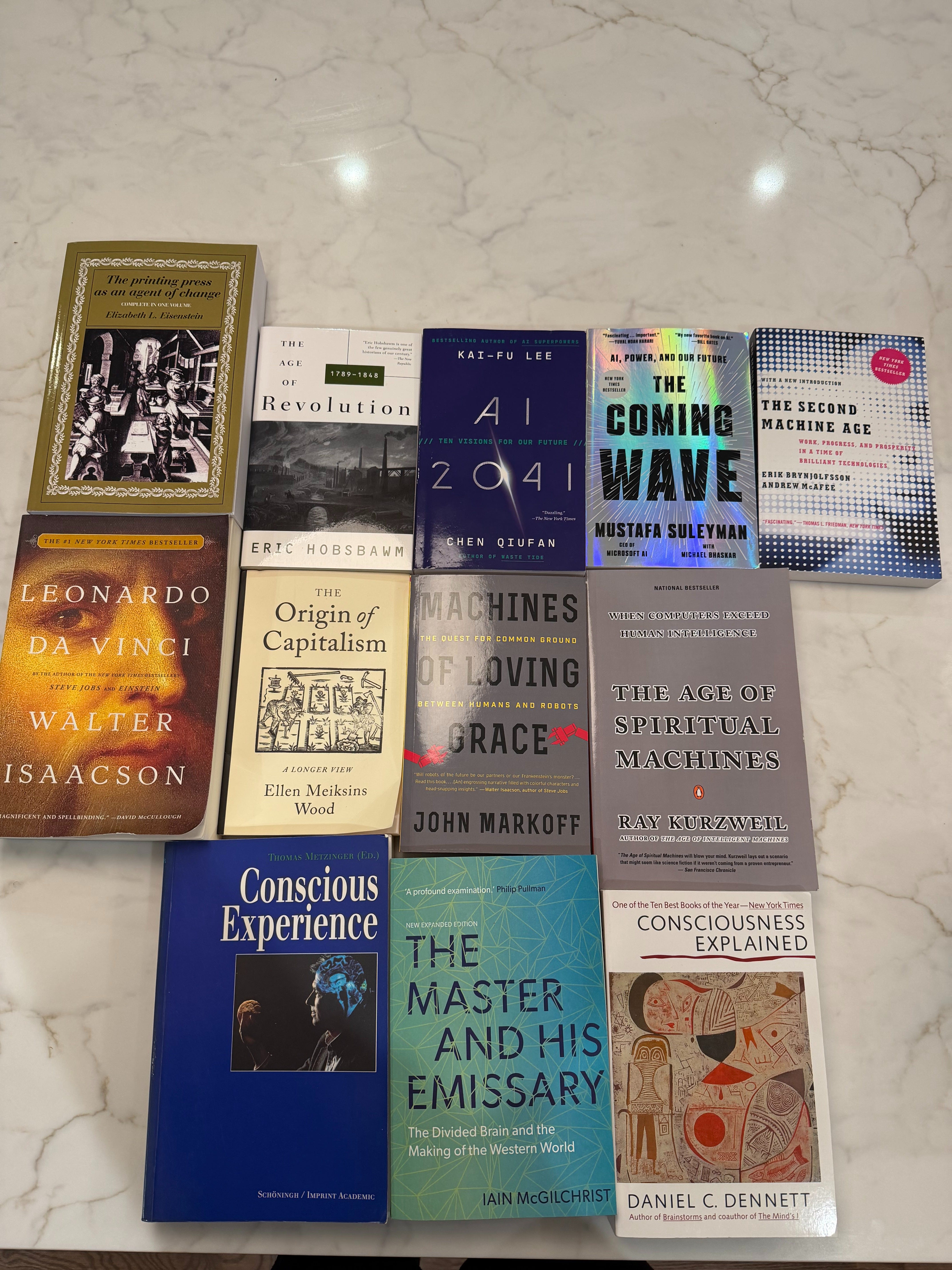
As I finish each book, I’ll write my reflections covering the author’s central thesis and provocations related to humanity, technology, AI, and where this moment in time may fit on the long arc of humanity. Truth is, I’m not exactly sure what each post will cover as that’s why I’m doing it. I suspect towards the end, I’ll look back and identify one or two themes that resonate clearest for me. No matter what, I know I will learn a lot.
Why am I doing this?
I love reading. And I love writing. But I’m doing this specific project because I believe there is something missing in how we talk about AI.
Most of the discourse today is focused on what to do — how to use the tools, move faster, automate daily workflows, and stay competitive. I agree this is valuable, but I also find it narrow. It is optimization for the layer directly in front of us.
When you think about what’s happening with AI, it is a shift cutting across multiple layers at once: technology, global politics, education, creativity, human cognition, philosophy, and so on. If you only understand one of the layers, or if you only focus on the layer in front of us, you have an incomplete picture of this period of change.
I’m looking for a full-stack understanding of how humans evolve with AI.
To build this mental model, I want to understand how humans adapted in past eras of rapid technological shift. I want to understand how today’s AI systems actually work and where their limits are. I want to imagine a wide range of future outcomes and stretch my grasp of what’s possible by dreaming big. And I want to ground myself with an understanding of the human mind itself — how we learn, develop, and create.
If I can zoom out across time, across technology, and across the human experience, I believe I’ll see clearly that humanity always finds a way to better itself. That’s the world view I want to raise my daughter with, and the impact I want to make.
I am a student of history, a lover of biographies, a tinkerer and builder, a dreamer, a writer, a techno-optimist, and a new parent. I believe in human potential. I believe humans can thrive in the age of AI and I’m going to write about it.
If you want to prepare yourself for this future in a more human way, follow along.
No. 1: The Gardener and the Carpenter
Alison Gopnik / 2016 / The Mind
My friend Chris Wang recommended this when I told him we were expecting a baby girl. I’d been meaning to read it for months but didn’t get to it until the first week we were home with the newborn.
The Central Argument
Alison Gopnik’s The Gardener and the Carpenter is built around a simple distinction. The carpenter treats the child like a project — define the outcome, apply the right inputs, shape them into a desired form. Whereas the gardener is focused on the conditions for the child: safety, richness, attention, security. With these conditions, the gardener allows the child to grow in their own direction. You don’t engineer any specific outcome, you tend the environment.
When I read this book in the first week of becoming a parent, I had two lasting reactions. First, it surprised me how recent the entire phenomena around “parenting” actually is. Parenting as a conscious practice, as a set of techniques and philosophies and anxieties about outcomes, is remarkably new. For most of human history, children grew up in loose communal structures with far less deliberate intervention from their parents. And the more intense, optimization-driven approach we now treat as normal is mostly a product of modern affluent culture.
Second, I was intrigued by the deeper claim behind why the gardener approach is a stronger parenting philosophy for raising children. The central thesis is that human intelligence developed the way it did precisely because we did not optimize for efficiency, but rather for adaptability. Humans have remarkably long childhoods — compared to other mammals — with far longer periods of open-ended exploration and curiosity-driven learning. This is a feature, and a primary reason why we can handle our unpredictable world with ever-increasing lifespans.
Carpentry in Raising LLMs
Since I finished the book, I’ve been thinking about this second point in the context of AI.
Today’s dominant paradigm with LLMs is fundamentally carpentry. We train models on massive datasets, define objective functions, and shape behavior through post-training. When the model encounters something new, it doesn’t learn from the experience in a meaningful way. A human steps in, curates new data, and retrains the system. The learning is centralized, controlled, and largely static once deployed.
Within this carpentry paradigm, LLMs can be incredibly powerful.
Where LLMs Are Already Superhuman
LLMs can read, synthesize, and generate vast amounts of information in seconds. They can hold and manipulate context at a scale that blows human capacity out of the water. When you use an LLM, it often feels like querying an oracle for wisdom: a magical system that can draw from a broad base of knowledge and respond immediately.
It’s helpful to decompose the power of LLMs into different dimensions of expressed intelligence.
One form is computational intelligence: processing information at scale, recognizing patterns, and generating outputs within a learned distribution. This is clearly where LLMs provide leverage.
Another form is contextual reasoning: taking a very specific situation, interpreting it, and producing a tailored response that reflects that context. Like when my wife and I have hyper-detailed questions about our baby’s health, we ask ChatGPT and get a wonderful response back in the time that it would take us to find our pediatrician’s phone number. These interactions make the systems deploying LLMs feel fluid and relevant.
Andrej Karpathy describes this as “ghost intelligence”.
Stated plainly, today's frontier LLM research is not about building animals. It is about summoning ghosts. You can think of ghosts as a fundamentally different kind of point in the space of possible intelligences. They are muddled by humanity. Thoroughly engineered by it. They are these imperfect replicas, a kind of statistical distillation of humanity's documents with some sprinkle on top.
It captures human-like reasoning and responsiveness, without ever grounding its knowledge in real-world, direct experience.
When you look at how LLMs are diffusing through the world, these two forms of intelligence already map to a very large portion of all human activity. Writing, large scale data analysis, creative work, summarization, coding, decision-making in complex scenarios. We want to believe each environment is bespoke, but there are enough stable patterns and defined objectives where the paradigm of LLMs will deliver substantial value in assisting or outright replacing human work.
The Gap That Will Eventually Matter
This is also where the boundary of the LLM approach becomes clearer.
A paper published this month by Yann LeCun, Emmanuel Dupoux, and Jitendra Malik — Why AI systems don’t learn and what to do about it: lessons on autonomous learning from cognitive science — makes this limitation explicit. Today’s AI systems learn very little once they are deployed. When they encounter something genuinely new, the learning loop breaks. Humans have to step in, gather new data, and retrain the model offline. The system itself does not continuously adapt to the world it is operating in.
It is clear that children do not learn this way. There is another form of intelligence expressed by humans and animals, that is missing in LLMs.
Adaptive intelligence develops through continuous interaction with the world. It requires updating your understanding as conditions change. And it requires the ability to shift between learning modes: observing, acting, imitating, imagining, and even day-dreaming — all in response to context.
As Gopnik outlines in her book, a child learns by moving fluidly between these different modes. A child’s learning is continuous and embodied, at times driven purely by curiosity rather a predefined objective. The gardener approach to cultivating intelligence focuses on creating the right conditions for the child’s character to emerge. By definition, this means conditions that involve unpredictability since the real world is full of uncontrollable elements. A child must display adaptive intelligence throughout her journey of development: encountering & learning from these conditions in the wild.
In a similar vein, LeCun has been arguing that the lack of adaptive intelligence is a problem for the entire technology industry’s bet on LLMs. He draws parallels to mental models on child-like learning, even citing Gopnik repeatedly in the paper.
One such thought exercise he proposes is the below system diagram: an architecture to facilitate seamless mode-switching between learning by observation and learning by action.
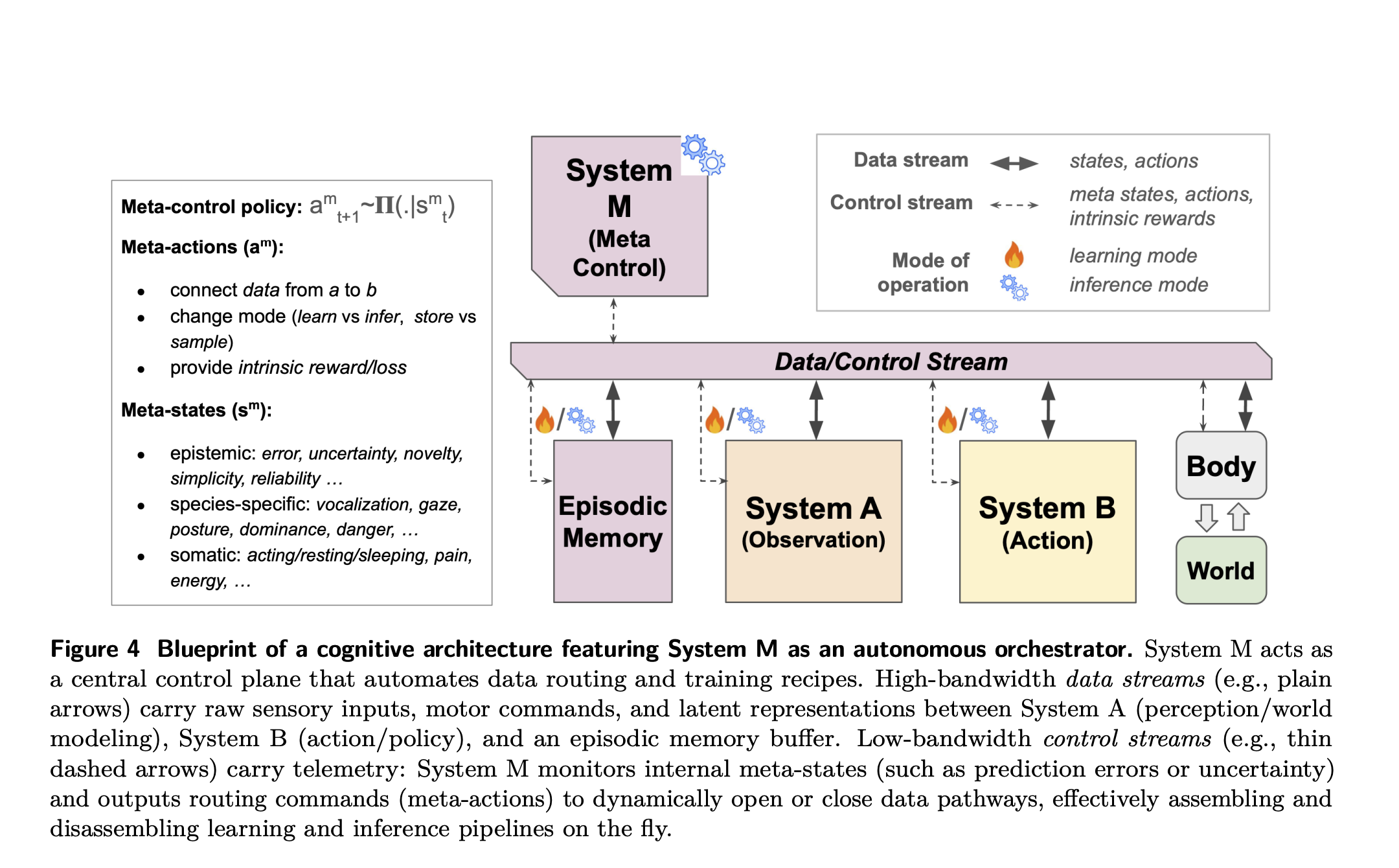
In November 2025, after more than a decade at Meta, he left to start a new company, AMI Labs — raising over $1 billion to pursue a different direction for AI. LeCun is betting on “world models” and an architecture called JEPA, which aims to learn abstract representations of how the world works, rather than predicting the next token in a sequence. As LeCun put it in an interview with MIT Technology Review, the goal is to build systems that “learn the underlying rules of the world from observation, like a baby learning about gravity.”
In Gopnik’s terms, LLMs are the carpenter. JEPA could be one effort to be the gardener for AI.
This distinction shows up not just in how models learn, but in how the frontier labs try to give them values. Anthropic has its Constitutional AI and its model spec. OpenAI has its own version. These artifacts are thoughtful and well-intentioned, but they share the same fundamental approach: a committee of humans defines what good values look like, writes them down, and trains the model to follow them. The character of the model is designed, specified, engineered toward an outcome. It is, in the deepest sense of the word, carpentry. The values are contrived rather than learned, assembled by committee rather than developed through experience.
In humans, values are not simply specified. They emerge through experience — through relationships, environments, constraints, and feedback from the world. They are shaped over time, not written down in advance.
As AI expands into more dynamic and less structured environments — where the conditions change and problems are more open-ended — the absence of these emergent properties of adaptive intelligence will become a limiting factor. It shapes the kind of problems AI can meaningfully address and what environments it can be deployed in.
A Different Starting Point
Over the past few weeks, I’ve started to see this gap more clearly at home.
My daughter is just a couple of months old, in the earliest innings of the most basic “firsts”. The signals of her intelligence are still small: brief moments of recognition, smiles and coos, pattern recognition and habit formation.
Her learning is emerging across many channels at once, shaped by the conditions around her.
It is very early. But it is the beginning of something that emerges over time. And it already points to a very different starting point for intelligence.
Back in December, I had written about the paradox of the current path of building intelligence in machines with LLMs:
Even as researchers worry about the gap between human intelligence and LLM-based intelligence, two truths can coexist — a paradox:
(1) LLMs are here to stay. We are on the scaling path and it will continue to work until it doesn’t. We haven’t seen how transformative this technology will be, because the models will get better and so will our ability to collapse them in more and more workflows. Coding agents may eventually look like training wheels for powerful AI on this path. And whether this path leads to a form of AGI or not is almost beside the point.
(2) Human-like intelligence requires knowing when and how to fight collapse. This form of awareness is something we have yet to see in machines.
You can argue whether that matters. But I’d counter it’s the most important gap to understand. Even LLMs hallucinating, something we frame as flaws, hint at something deeper we don’t yet grasp.
I keep coming back to how clearly building human-like intelligence requires something that LLMs do not have. When I look at my daughter, it is even more obvious.
Perhaps the near-term goal in AI is a capital race to allocate the narrow intelligence to the world order: to pursue the first path. If the goal were to truly recreate man’s intelligence in machines, it’d require something else. Human intelligence requires continuous adaptation and we’re still far from understanding how we cultivate this ourselves beyond being gardeners.