The Human Curriculum No. 2: The Origins of Capitalism & What The Abundant Intelligence Era Might Break
Exploring how capitalism evolves when intelligence, not labor, becomes the foundation of survival
In the first post of The Human Curriculum, I examined how human intelligence emerges through the lens of parenting. The guiding frame for this reading series is to move across time. I want to build a fuller understanding of humans in the age of AI, so that also requires going backward — to moments when society reorganized itself in response to new capabilities, constraints, or ways of creating value.
In this installment, I attempt to study one of the most consequential transformations in history: the emergence of capitalism.
No. 2: The Origins of Capitalism
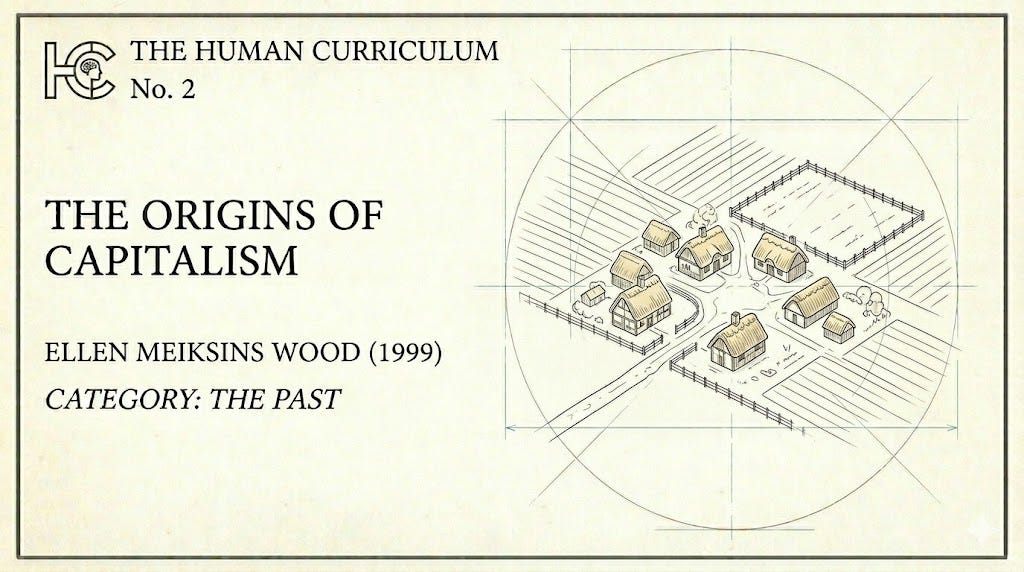
Ellen Meiksins Wood / 1999 / The Past
I picked this book because I didn’t actually have a clear mental model for how capitalism came to be. I had absorbed some vague version of the story from high school history classes: that as societies became advanced and more capable, markets expanded and trade increased — giving rise to capitalism as a natural outcome of progress. But I wanted to go deeper and find more nuanced views.
The Central Argument
Wood’s argument starts by challenging the exact version of the origin story I had in my head. Viewing capitalism as a natural extension of societal progress was often associated with thinkers like Adam Smith. Others, like Karl Marx, similarly posited that capitalism emerged as a stage in historical development.
But Woods contends that markets have been around for a long time, and that alone wasn’t enough to give rise to capitalism. Her central claim is that capitalism begins when markets become the primary condition of survival. It isn’t enough for the market to exist.
She introduces a distinction between market opportunities and market imperatives.
A market opportunity is something individuals can choose to engage with. They may sell goods to improve their situation, but their survival does not depend on that choice.
A market imperative means participation in the market is no longer a choice. People must engage in exchange to maintain their livelihoods and their survival becomes tied to performance in the market.
Wood argues that capitalism emerged in rural England between the 16th and 17th centuries because market dependence became widespread as traditional feudalism broke down:
Landlords could no longer rely on fixed dues or customary obligations to sustain their income. Instead, they faced pressure to generate returns from their land. To survive and compete, they began consolidating land and leasing it out at market rate
Tenants then competed for access to this land and were forced to strive for operational efficiency to clear the market rate
Peasants lost access to common land through enclosure and it became more difficult for them to survive outside the market
As a result of this shift, survival for all parties was no longer dictated by custom or obligation, but by competition, rents, and exchange. In England, the market itself became the mechanism of coercion and Wood argues that this was the origin of capitalism.
My Reaction
Since I read this book after the human intelligence parenting post, I found myself still thinking about intelligence.
In the previous essay, I explored intelligence as something that could be decomposed, scaled, and, in many ways, replicated. LLMs already exhibit forms of jagged, superhuman intelligence.
In this essay, the question shifted from what intelligence is, to how the value of intelligence in capitalism evolves when it is abundantly available.
Wood asserts that capitalism is not just a system of markets, but a system that organizes survival. So if capitalism emerged when survival became dependent on markets, what happens when the conditions for survival change?
Does capitalism adapt?
Or does something else take its place?
The Thought Exercise: The Intelligence Era
To begin, let’s start with a simple assertion:
AI is beginning to change the relationship between labor, intelligence, and production.
In the digital world, we’re already seeing systems that can write code, analyze information, and execute tasks with minimal human input. The combination of stronger base models and better “harnesses”—the environments that let them act—has meaningfully increased their utility.
This approach can extend beyond coding as the first horizon, and rapidly expand into broader knowledge work too. Anything that a human does on a computer screen can be trained for, as we scale our models with more compute, data, and algorithms. We can imagine different paradigms also extending to the physical world, with advancements in robotics and automation.
For the thought exercise, let’s imagine a future world where both cognitive and physical labor become less central to production because we’ve invented various forms of digital and physical AI that are intelligent.
In that world, access to intelligence is the key input for human productivity.
Mapping the Parallel
In agrarian capitalism:
Land was the key resource
Landowners controlled access
Tenants depended on leases
Peasants lost alternatives and became dependent
In the intelligence era:
Intelligence becomes the key resource
Frontier labs and infrastructure owners control it
Companies and builders depend on access
Some workers are displaced and struggle to re-enter
So the question becomes: what determines access to this new resource?
The Bottleneck
At first glance, it might be tempting to assume intelligence simply becomes cheap. Although AI is increasingly capable and available, it is still physically constrained. The limiting factor is the infrastructure to produce and deploy AI at scale.
In the near term, that constraint shows up in chips, memory, and supply chains—things like advanced GPUs, high-bandwidth memory, and the limited fabrication capacity required to produce them. Over time, it shifts toward energy and the physical buildout of data centers, where scaling frontier models increasingly means deploying infrastructure at the scale of gigawatts.
And increasingly, it’s not just about having compute—it’s about having the right compute. As models are co-designed with specific systems and optimized for tokens per watt and FLOPs per dollar, access becomes less portable and more concentrated.
Intelligence is becoming a capital-intensive good.
A Strawman: When the Market Stops Mediating Survival
This results in a simple dynamic: intelligence may become broadly available, but the highest-leverage intelligence still remains tied to capital. Access to this capital will not be evenly distributed, and you can imagine how the structure of the economy starts to change.
Companies that can afford large-scale inference gain disproportionate leverage. A small number of people, equipped with enough intelligence, can now do the work that previously required hundreds or even thousands of humans.
At the same time, a growing number of people find that the work they once did no longer clears the market. The work is still valuable, but less so because it can be done more cheaply and efficiently by systems that scale.
For everyone else in the market, the equation changes. If you can’t sell your labor in a meaningful way, and you can’t afford sufficient access to the systems that replace it, what role do you play in the market?
Your survival in that world may depend on something else: redistribution of access, public provisioning, guaranteed access, policy decisions. In other words, extra-economic forces. This is the inversion of Wood’s argument where survival becomes decoupled from the market. If that happens at scale, capitalism could stop being the system that organizes survival.
An Alternative Path
There could be another way. What if capitalism evolves with the abundance of intelligence? Is it possible that the scarce resource of value shifts from intelligence to something else?
I think so. Intelligence can be a tool, and not the bottleneck to mankind’s progress. It can amplify what humans can do, rather than replacing it altogether. Value creation in the market for all participants does not disappear, it shifts towards what remains scarce. Things like:
Execution in the physical world
Shared human experience and connection
Coordination across people and systems
Capital-intensive deployment in domains like robotics, infrastructure, and energy
Trust, taste, and human judgment in an increasingly synthetical world
These problems don’t get easily solved by abundant intelligence. They require capital, risk-taking, coordination, and navigating real-world constraints. In this version of the future, intelligence can remain unevenly distributed but its value is repriced.
It becomes an input that lowers the cost of creation, expands the frontier of what’s possible, and opens up new domains for markets to form around.
Capitalism rebalances through new forms of value creation.
My Final Reflection
But even this alternative outcome is not guaranteed.
If Wood’s core insight is that capitalism emerged when markets became the primary condition of survival, then the intelligence era forces a more fundamental question:
What happens when the most important input to production—intelligence—can be scaled independently of humans, but not independently of capital?
On one end, you can imagine a system where access to intelligence is concentrated, participation in the market shrinks, and survival depends on forces outside of it.
On the other, intelligence expands what’s possible, new forms of scarcity emerge, and markets reorganize around them.
Both seem possible, but which one we end up in likely won’t be determined by the technology alone. It’s how we choose to build, distribute, and govern it.
Capitalism may not have been inevitable. If it was conditional, the conditions may be changing again.