The IMO Moment: Glimpses of the Future
Unpacking OpenAI's bombshell announcement about reasoning models achieving IMO gold
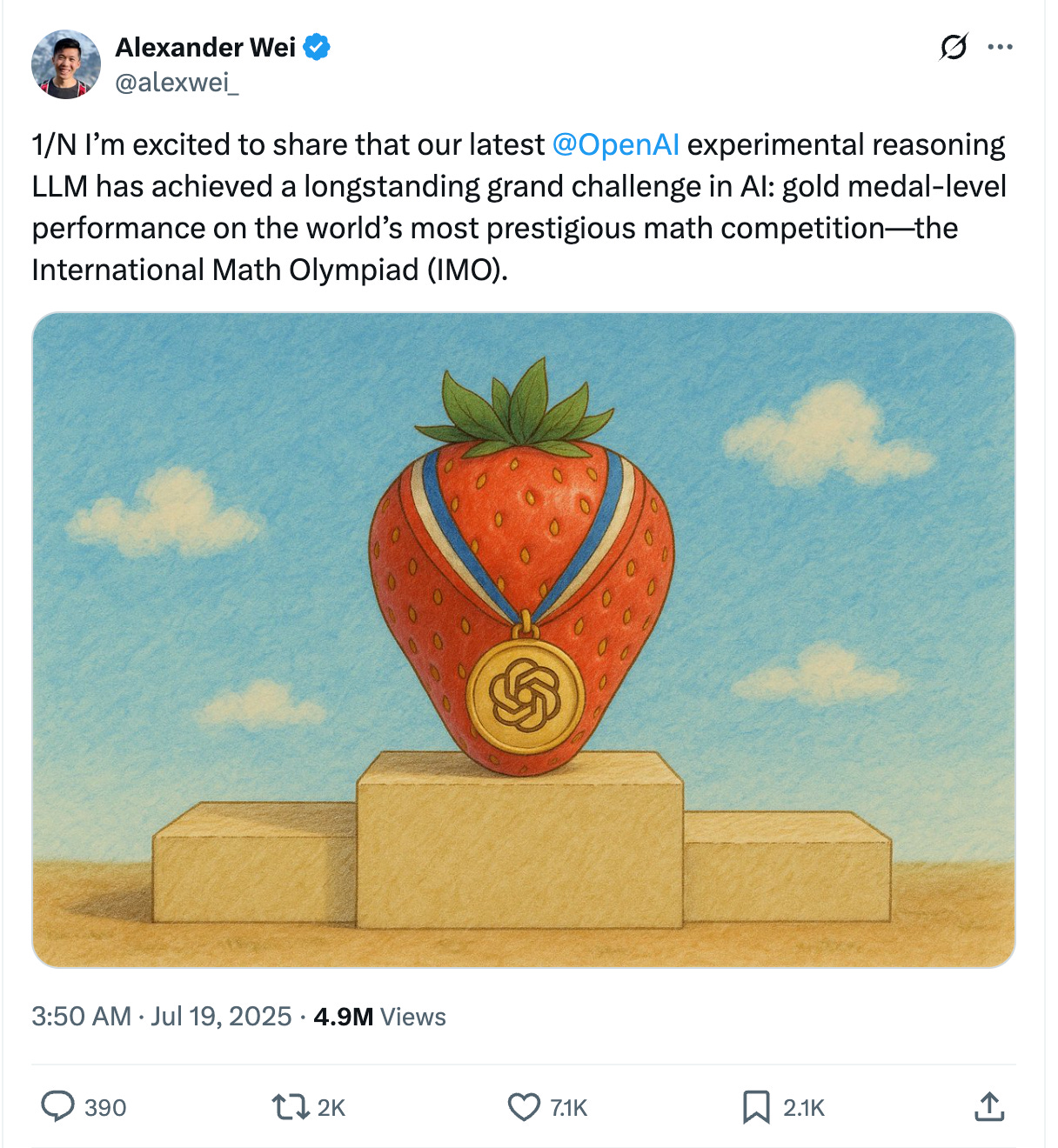
At 3:50 am on Saturday morning this past weekend, OpenAI dropped a bombshell: their experimental reasoning model won an International Math Olympiad (IMO) gold medal.
As I was waking up and making sense of how and what this meant, my X timeline was exploding with reactions. It felt like it came out of nowhere. Just a tweet, casually posted in the middle of the night. But the implications could be huge. A model just achieved gold in one of the hardest math competitions in the world.
As I digested various takes over the weekend, I started unpacking how important this milestone could be.
First, the timing is telling
There is something wild about how this announcement was made. No blog post, no livestream, no research paper. Perhaps even no formal coordination with IMO organizers. That is a signal of the moment itself.
There’s already drama that OpenAI didn’t wait until the closing ceremony of the IMO to drop the announcement. A little over an hour ago, Google’s DeepMind confirmed they also achieved an IMO gold with DeepThink. And they threw some shade at OpenAI for not waiting until Monday to make it official.
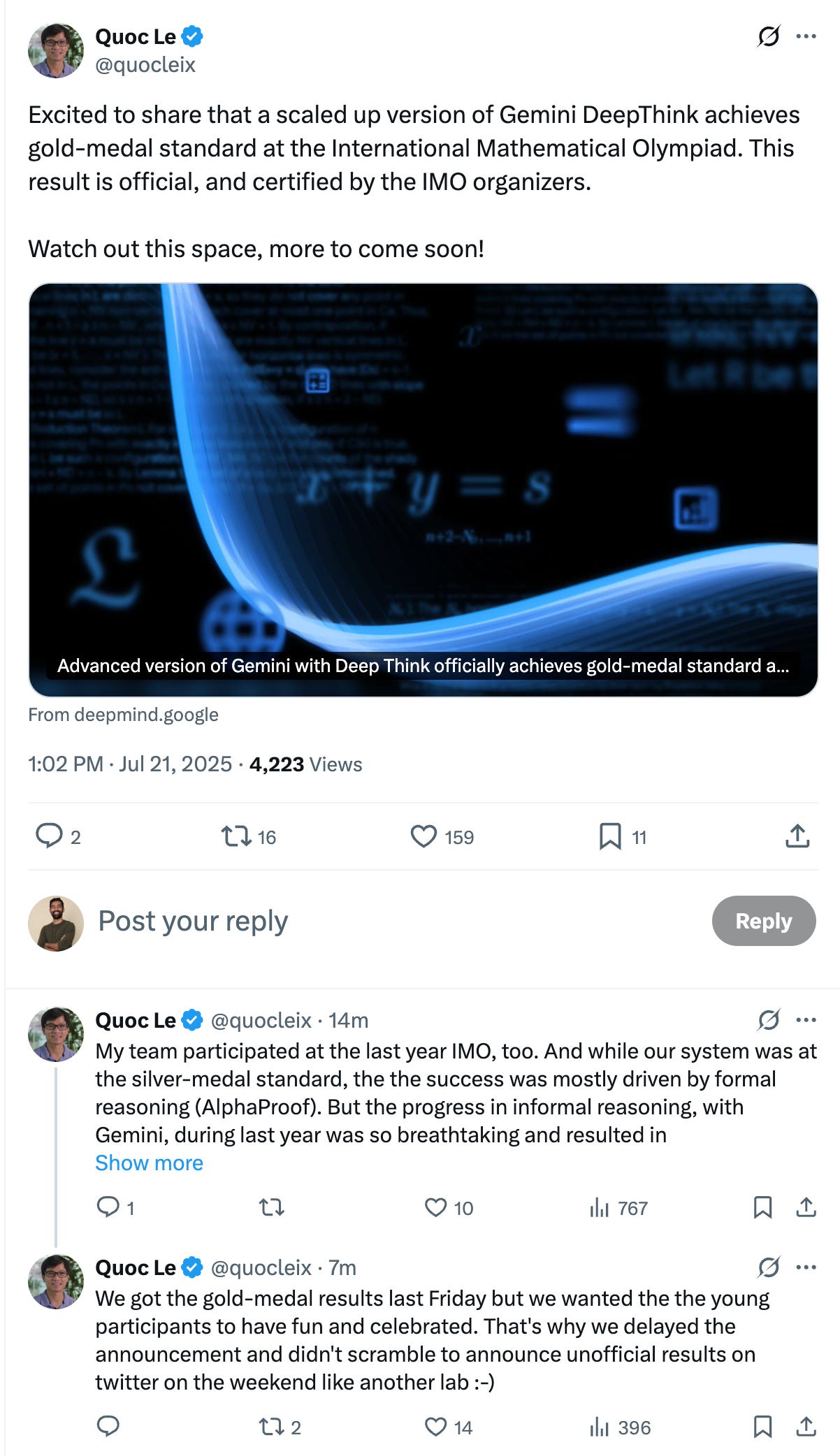
The pace of AI innovation is outpacing our ability to process it. We’re seeing a fast-moving, competitive landscape between large players who want to control the narrative. The stakes are sky high and they’re willing to play dirty.
Second, this is happening way faster than anyone expected
Taking a step back, you have to contextualize what the IMO is. From Deepmind’s announcement last year when its models AlphaProof and AlphaGeometry2 achieved a silver medal:
The IMO is the oldest, largest and most prestigious competition for young mathematicians, held annually since 1959.
Each year, elite pre-college mathematicians train, sometimes for thousands of hours, to solve six exceptionally difficult problems in algebra, combinatorics, geometry and number theory. Many of the winners of the Fields Medal, one of the highest honors for mathematicians, have represented their country at the IMO.
More recently, the annual IMO competition has also become widely recognised as a grand challenge in machine learning and an aspirational benchmark for measuring an AI system’s advanced mathematical reasoning capabilities.
Many experts believed we were still 5-10 years away from reliably solving IMO-style math. For example, Anthropic’s research throughout 2025 showed that even with chain-of-thought prompting and extended thinking, model performance on Olympiad-style math problems was constrained (source #1 and #2).
Months ago, people didn’t think this kind of performance was anywhere near possible. Yet, here we are.
Third, the how is just as important as the result
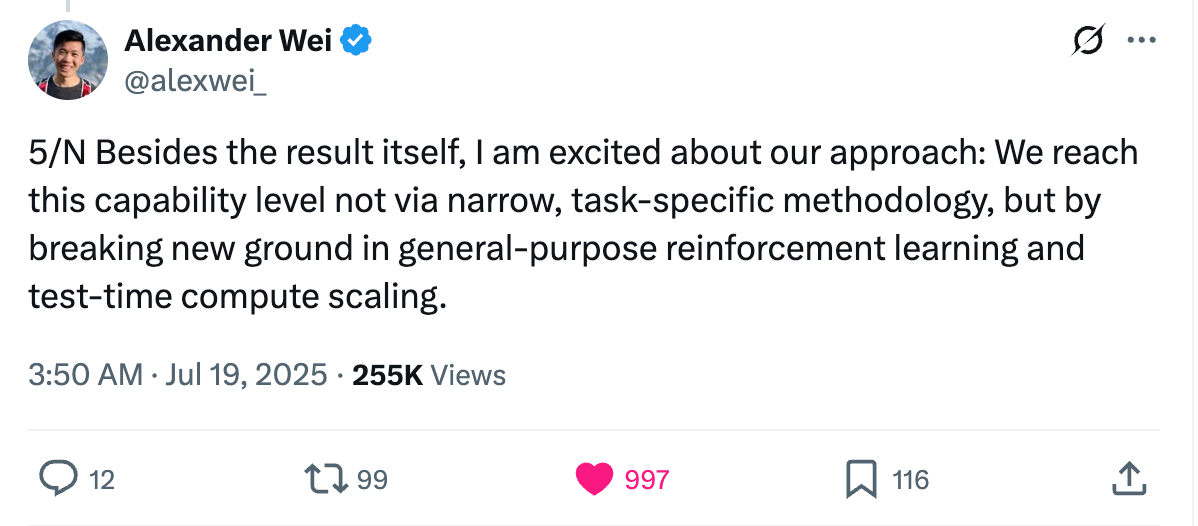
What’s particularly fascinating is the breakthrough on how the experimental model was trained and evaluated. According to OpenAI’s researchers, this was not a case of “train on more data”. This wasn’t achieved through more pre-training or even more task-specific reinforcement learning.
The insight seems to have come from two big levers: general-purpose reinforcement learning and test-time compute scaling.
What does that mean, and why is that important?
Pretraining gives a model baseline knowledge. This isn’t enough to solve hard, novel problems like the IMO, where the challenge is more than recalling facts. The model’s capability is augmented by post-training, which typically involves reinforcement learning from human feedback (RLHF). An intuition has been that you can teach models how to think beyond what they were pretrained on, if you expose and reward them for learning new domain-specific tasks through RLHF.
For a domain like IMO-style math problems, this is particularly challenging because the “labeled” data that a model can learn from (either in pre-training or RLHF) is limited. Solving these problems typically requires a form of true reasoning or creativity. And it’s historically a tough benchmark for AI models because we’ve long believed humans are uniquely capable of solving these type of problems.
In this announcement, the implication is that the model learned the domain of IMO problems without more exposure and verifiable rewards for domain-specific tasks. In other words, this was “general-purpose” feedback —without being explicitly taught how to solve “more hard, math problems”
The second lever of “test-time compute” is interesting because it gives the model more time to think at inference. This loop might be expensive but its implications are also important. It brings models closer to how humans solve hard problems. We go beyond the first idea that pops into our heads. We try things, fail, backtrack, refine. It is the creative aspect of thinking and reasoning embodied in LLMs. We take our time to learn.
When you take these two levers together, it represents a new path forward on improving model reasoning. This path is exciting to me because it highlights how learning is an emergent property. One that is not bottlenecked by exposure to the distribution data. On that path towards making LLMs more capable, we may be headed towards a self-teaching loop that truly accelerates the AI race.
Glimpses of the Future
In tech, there are strange little moments that feel like time machines. They don’t always announce themselves as pivotal.
Do you remember your first Google search? When you realized you would have access to infinite knowledge at your fingertips?
Do you remember your first ride in a Waymo? When you realized that cars driving themselves would become a normal thing some day?
Do you remember the first time you had a real conversation with ChatGPT? When you realized LLMs blur the lines between machines and sentient beings?
Each of these moments is more than a product milestone. They give us little glimpses into where the world may be going. We don’t fully understand how we’ll get there, but we can intuit that it’s the future. We don’t fully understand what it took to get that glimpse, so it feels a bit like magic.
Reading about the way these reasoning models achieved an IMO gold medal gave us another glimpse that we can feel indirectly. This future is one where models could perhaps learn and teach themselves how to think creatively, because intelligence is emergent. That is one hell of a glimpse.