The Human Curriculum #4: On Staying Awake
The life of a genius and remembering to live fully present in your own life
One of my favorite things to do as a new dad has been walking into the nursery to wake up our baby girl.
I love it because of the way she wakes up. I expect her to be slightly cranky or even bewildered, the way most of us would be if someone pulled us out of sleep. But most mornings, she wakes up the same way.
First, she locks eyes with me as I approach the crib. Then, she cracks a tiny smile that gradually widens until her whole face is beaming. She slowly looks around to situate herself, as if she’s remembering where she is. She never breaks the smile. Sometimes, if I’m lucky, she throws in a few happy leg kicks because why not.
When Sona wakes up, I can tell she is awake. Fully, completely, unmistakably there.
The fourth installment of The Human Curriculum is about that quality of awakeness, and what reading Walter Isaacson’s biography of Leonardo da Vinci made me think about how to live with it.
No. 4: Leonardo da Vinci
Walter Isaacson / 2017 / The Past
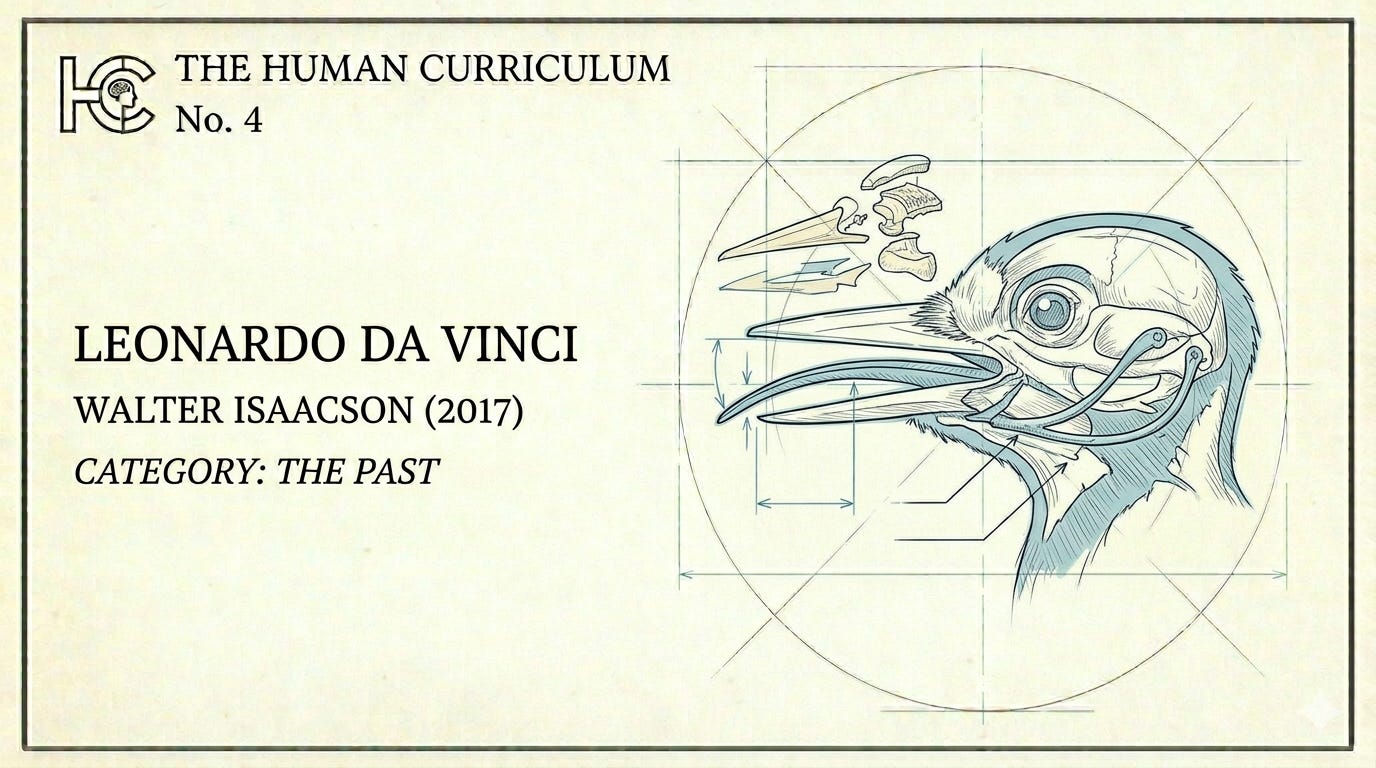
In classic Isaacson fashion, the book is meticulously researched and full of the kind of specific, almost unbelievable details that make a life feel real.
Da Vinci was an eccentric genius, one of the greatest polymaths who ever lived. His creativity was unmatched and his imagination was wider than seemed possible.
What comes through on every page is the obsessive, relentless, almost childlike quality of his curiosity. He spent years wondering what happens to a woodpecker’s tongue when not in use. He dissected dozens of human bodies to understand how blood moved through them. He procrastinated on paintings for decades and returned to them only when something finally clicked. He filled countless notebooks with carefully detailed observations about the flight of birds, the way light bounced off water, the mechanics of a human smile. His thirst for knowledge was often not strategic or part of some elaborate ruse to gain more money, fame, or power. He wanted to simply understand things for himself, for the pure pleasure of understanding them. Most of the time, that knowledge had no practical application. But he didn’t care.
Isaacson argues that this quality defined him as a genius. He saw the world in a way that was unmistakably his own because he never stopped asking why. In this sense, he behaved like a child. We say that like it’s a limitation, but da Vinci understood it as a gift.
Reading this book, I kept thinking about how each of us has some da Vinci in us. The childlike wonder we came into this world with. The thirst for knowledge for its own sake. The tendency to fall down rabbit holes for no good reason. I remember having all of these qualities as a child, and struggling to find ways to hold onto as many of them as I grew up and grew out of them.
Da Vinci reminded me what happens when you succeed in maintaining these qualities. When you stay faithful to that inner curiosity, when you live fully awake to whatever is in front of you, and when you show up as yourself every day. You get to experience the wonder of life on your own terms.
I am not saying I want to live exactly the life da Vinci lived. But when I look at his life and think about my daughter’s smile, I think about my own relationship to awakeness across different stretches of my life. I have to be honest: there have been long periods where I was not awake. When my hands were on the wheel, but I was not the one driving because a fear of some kind was clamoring for control. I was not there in the way Sona is there when she opens her eyes every morning.
Reading about da Vinci while becoming a father for the first time was its own kind of collision. The concept of awakening lives in many schools of thought across religion, spirituality, philosophy, and literature. In Japanese tradition, there is satori — a conscious awakening, a second birth where everything before is before and everything after is after. Confucius talks about having two lives, and the second begins when we realize we only have one. Dante opens The Divine Comedy with: “midway through the journey of our life, I came to myself in a dark wood, for the straight way was lost.” Different centuries but the same recognition that if we’re lucky, at some point in our lives, we wake up to the life we’ve been living.
It should be no surprise then that having a child was that kind of experience for me. When I think about the life I want to live ahead of me, I want to consistently choose to stay awake. I want to hold onto my ability to notice things, to follow questions for the pleasure of following them, and to look at the world exactly as it is.
Are you awake?
The universe is trying to say something. Are you listening? The universe is trying to speak.
Are you awake?
Your life is happening to you every second, every minute, every hour going by.
Are you awake?
You’re trying to tell yourself something. Are you awake or are you even listening? Every bird that sings, every leaf that rustles in the wind, every drop of water that ripples in the pond. As it always was, as it always will be.
Are you awake to your own insignificance and yet to its exact significance?
The fact that it doesn’t matter is exactly why it should matter.
Are you awake and are you listening? Are you awake and will you do something? Are you awake and will you stay that way? The universe is listening. The universe is waiting.
Yes. I am awake.