Personal Agents and the Roles We Learn to Play
How Grok Bot, Instinct, Town, ChatGPT, Claude, and Muse borrow familiar identities and teach us new roles to play
Unless you’ve been living under an AI rock, you’ve probably seen the tech world raving about Grok Bot or Instinct recently. The excitement around the “personal agent” era of AI assistants is picking up steam as software is increasingly handling the kinds of errands and loose ends that make up everyday life.
Grok Bot launched on August 11 with always-on agents that can work across applications and coordinate with one another. Instinct has been all the rage in August, with users raving about how the agent can help with everyday responsibilities in a simple text conversation. And on September 8, Meta introduced Muse, its personal agent that can keep working in the background.
By personal agents, I mean software we return to, give context to, and entrust with responsibilities over time, whether we use it for life or work.
In When Software Recedes, I wrote about a future in which software bifurcates: the invisible layer runs beneath the surface while operated by agents, and the visible layer becomes more concentrated around things worth our direct attention. We will be surrounded by more software while spending less of our lives navigating it.
These recent products make that possibility feel rather concrete. When you text your agent to make a dinner reservation or check you into a flight, it stitches together several steps of using software in a single motion without requiring you to visit each destination. As this shift plays out, we’re left with an important question about our own role: if agents take over more of the operating, how do we become good at directing what happens?
Today’s products offer a few different starting points: an assistant you text, a bot with its own computer, a roster of specialists, or a character that feels closer to a digital pet. Each gives us something familiar to relate to. We might intellectually know we’re interacting with software and still respond to it as a colleague, companion, or small being with a personality of its own.
I want to separate that relationship from the role we perform. The relationship is how I experience the agent: as a colleague, companion, or pet-like presence. The role is how I act: as a manager assigning responsibilities, an editor shaping an argument, an investigator testing explanations, or a collaborator thinking something through. A familiar relationship gets me comfortable participating; it doesn’t determine every role I can play within it.
While I think familiar relationships will help personal agents become approachable, we should be careful about letting any one of them dictate how we use the technology. Human management carries assumptions about stable specialization, limited attention, knowledge transfer, and motivation. A pet metaphor brings expectations about temperament, care, and emotional needs. Neither gives us a complete account of software that can be replicated, temporarily specialized, and reorganized around a task.
My bet is that the durable skill will be role-playing: learning how to act within—and eventually beyond—the relationship a product first offers us. The meta-game is learning how to choose and revise our role as the work changes. The same Muse avatar can remain familiar while I move from sharing preferences to directing a task or critically examining its result. The strongest products will help us make those transitions.
Two choices hiding inside the agent interface
There are many ways to analyze personal-agent products: their interfaces, integrations, proactivity, underlying models, and computer infrastructure. For this essay, I want to isolate two choices about the experience they offer:
One primary agent or several visible agents? Do I return to one point of delegation, or choose among distinct agents with responsibilities of their own? A single personal agent might coordinate many subagents behind the scenes. The axis describes what the user has to relate to.
A being-like relationship or system-like controls? Does the interface encourage me to relate to a character with identity, personality, and presence? Or does it primarily organize my attention around tasks, progress, resources, and outcomes?
“Being-like” is deliberately broader than “human-like.” A product can make its agent visibly artificial while giving it the presence of a creature or companion. The question is whether I’m encouraged to relate to something as if it has a life and disposition of its own. That is a design effect, not necessarily evidence that the system is alive or has feelings. Visual design helps establish this relationship, but is not always required. For example, Instinct can feel like a person through text alone. Or a character can also act as a convenient handle for a set of system controls.
These axes give us four broad arrangements: one personal companion, a team of characters, a system directed through one assistant, and several visible capabilities without enduring character identities.
The horizontal axis counts visible points of delegation; the vertical axis describes the relationship the product encourages.
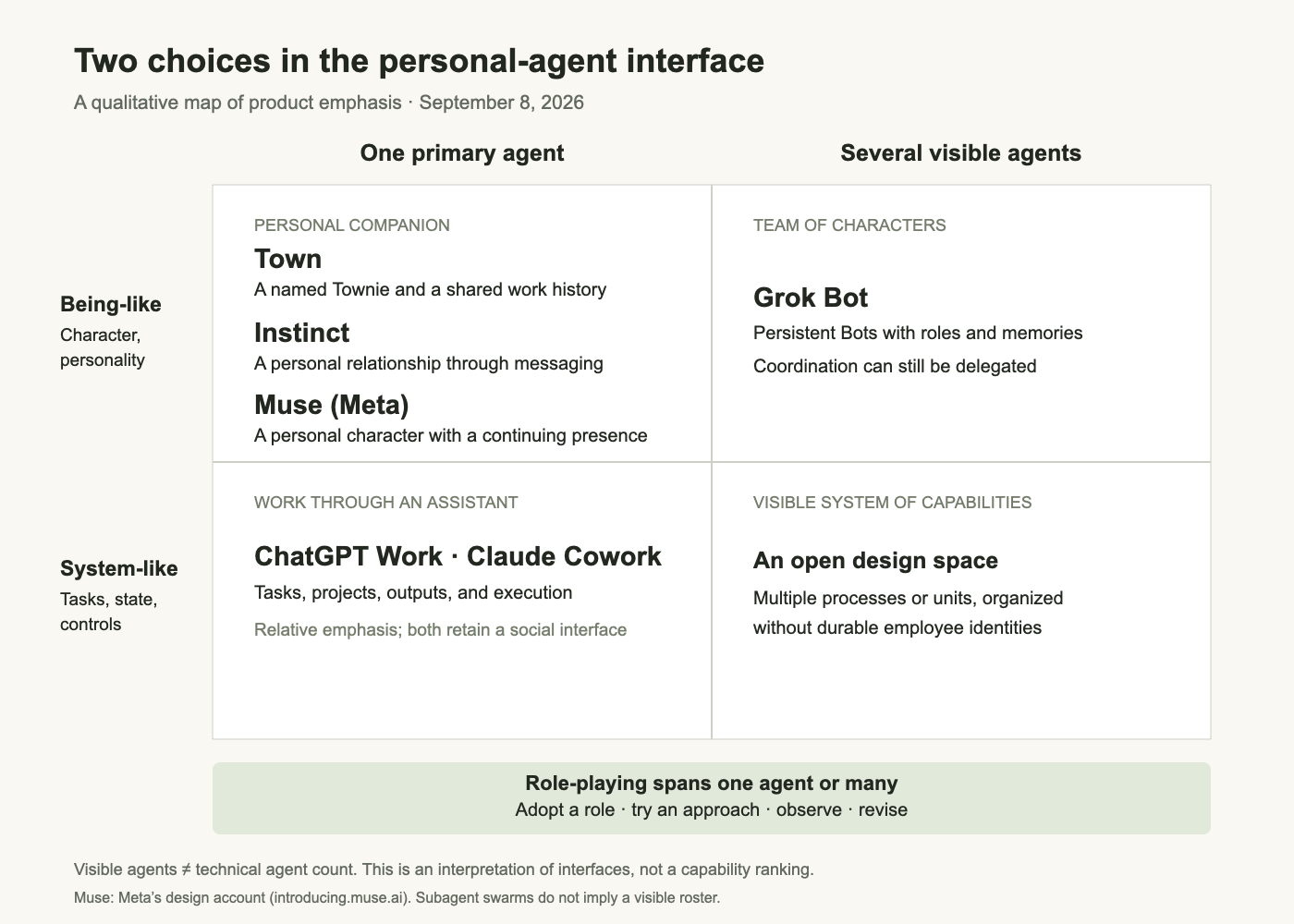
What role does each product invite us to play?
The map describes the relationship each interface foregrounds. I’ve broken down assistant products against the following questions: what role does this product invite the user to perform, and what might that role help them learn—or prevent them from seeing? These are my interpretations of the interfaces, not fixed limits on how they can be used.
Grok Bot: learning to direct a team of multiple agents
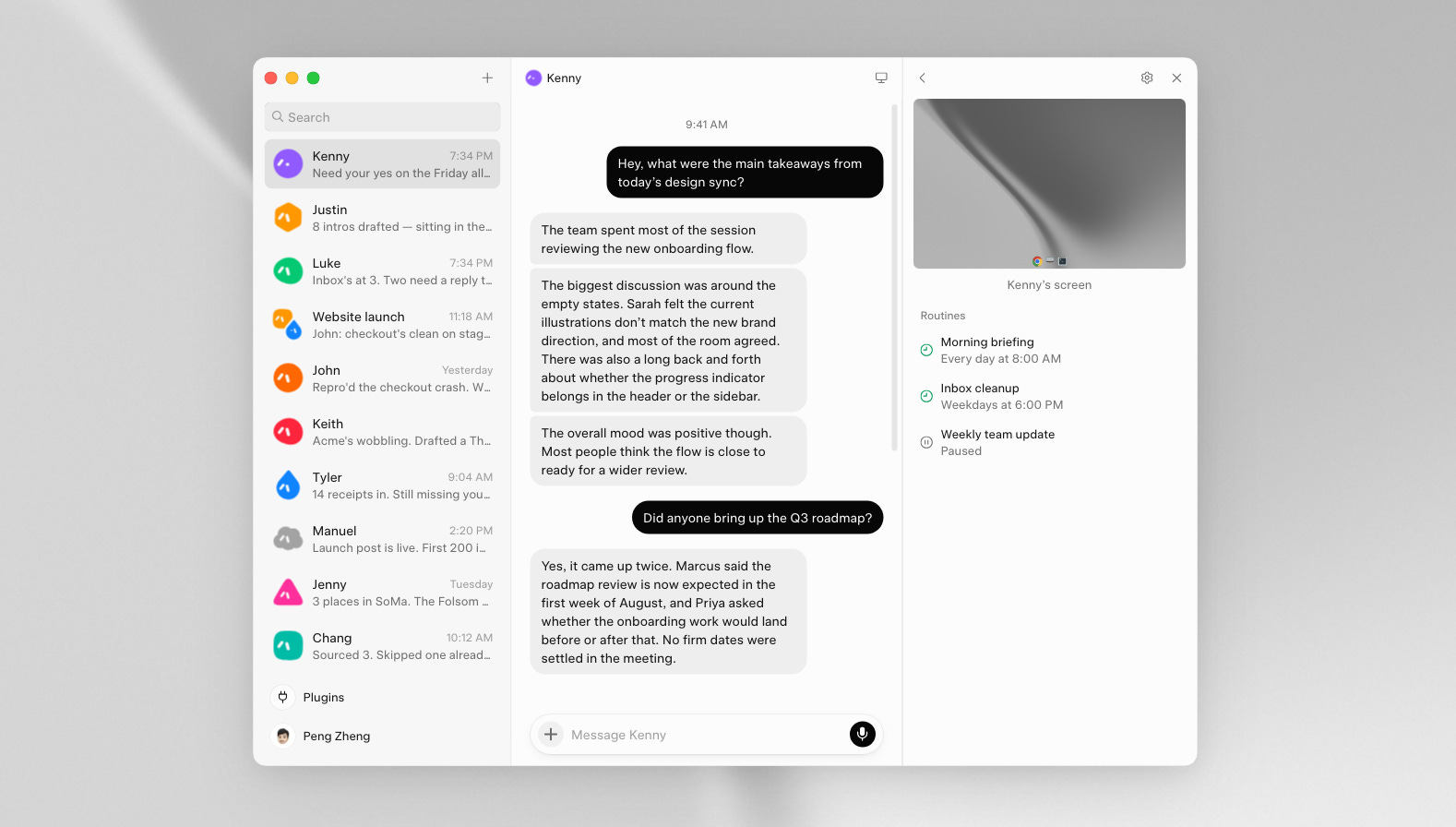
Grok’s official design demo: a Bot roster, conversations, and routines.
Grok Bot offers the relationship of a digital team with many agents. Its design account describes persistent Bots with names, memories, routines, and computers. Ongoing responsibilities have recognizable owners, placing it on the several-visible-agents side of the map.
That structure invites you to act as a manager: define responsibilities, supply context, and decide where work belongs. Bots can also coordinate and proactively bring in specialists themselves, so the user’s role can move toward setting priorities and reviewing outcomes instead of dispatching every task.
This product arrangement teaches you to practice acts of delegation. But its potential blind spot may be from treating the existing roster as the only shape of work to be done. Becoming more capable may mean recognizing when to rearrange the roster, rather than giving an existing Bot another task.
Town: learning to make shared context explicit with a single agent
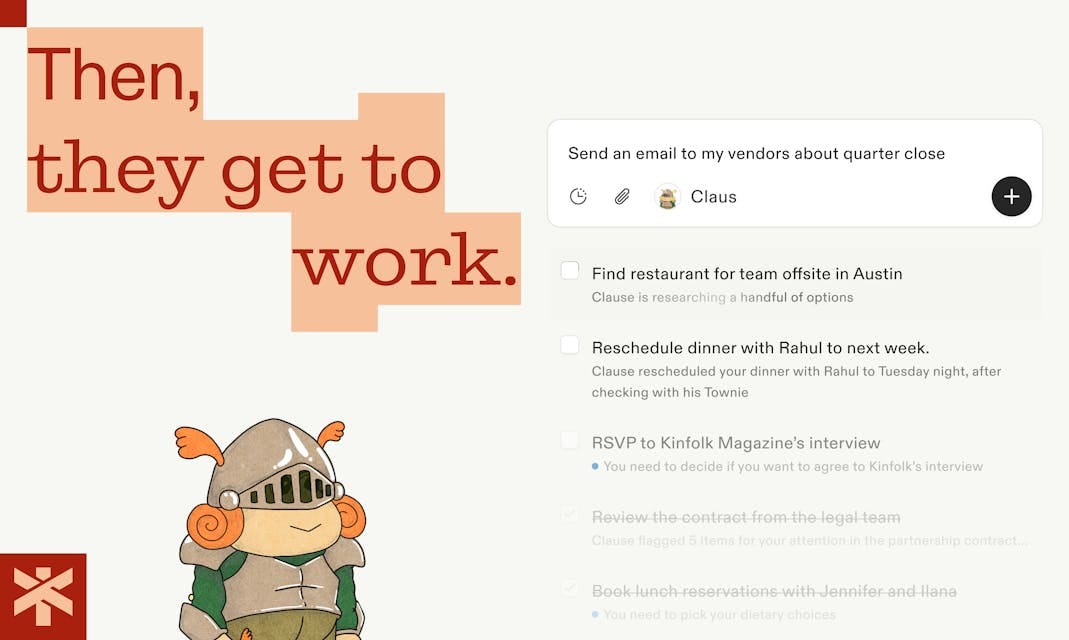
Town’s official demo makes progress and requests for input visible in a to-do list.
Town offers one continuing relationship with a named Townie. There is a wiki, to-do lists, routines, and suggestions to make its knowledge and responsibilities visible. You can message your Townie, and even add them to group texts with non-Town users so the relationship enters shared conversations.
The experience invites you to be a collaborator who makes context and commitments explicit to your to Townie. You explain what matters, inspect what the Townie knows, and work through the responsibilities it has accumulated. The wiki and task list give you places to act on that understanding.
This can teach you to diagnose a stalled task: is the goal unclear, is context missing, or is a decision waiting on you? But the possible blind spot is in assuming an ongoing relationship with Townie means that the assistant already understands enough.
Instinct: learning to turn conversation into direction with a single agent
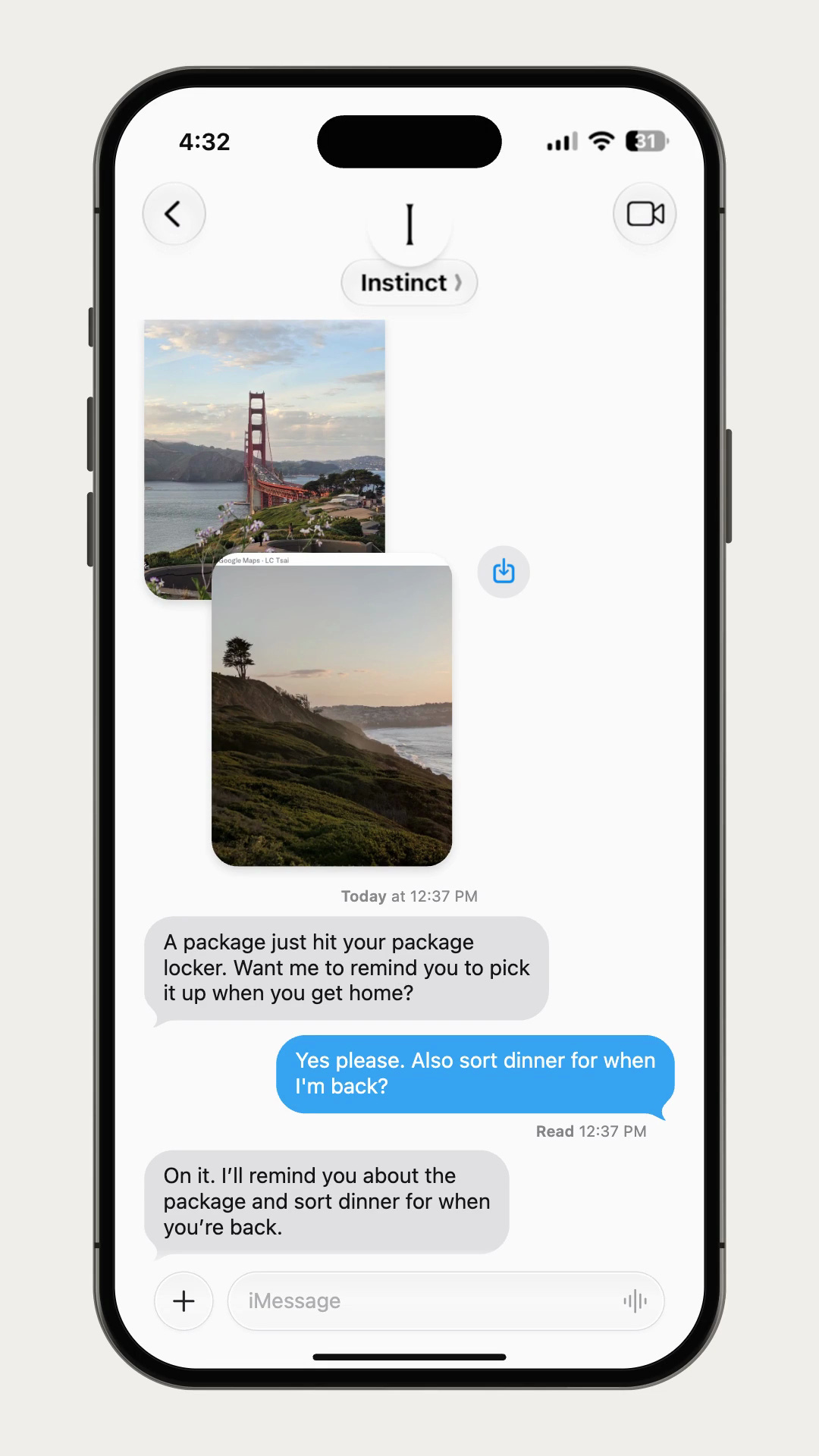
A still from founder Noah Shinn’s location-sharing demo: Instinct notices a delivery and offers follow-through when the user gets home.
Instinct starts with one primary relationship through a number you can text. You connect various tools to give it data as context to offer help. A core belief is that there should be no new interfaces so much of the work is done and handled through the single text conversation.
I have my texts with Instinct pinned to the top of iMessage as a “favorite contact.” It feels like talking to a person, though there is no visual affordance for this beyond being a contact I text. As it learns more about me, the relationship can feel like someone looking out for me. That familiarity invites me to think aloud and share context before I have a fully formed request.
I’m taking on the role of director with the challenge turning every conversation into usable direction. I can discover requests by talking, then learn when a preference needs to become an explicit constraint or an outcome needs explicit checking. For me, the blind spot is whether the feeling of being understood actually equates to the agent correctly understanding the particular task.
ChatGPT: learning to commission and evaluate work with a single agent
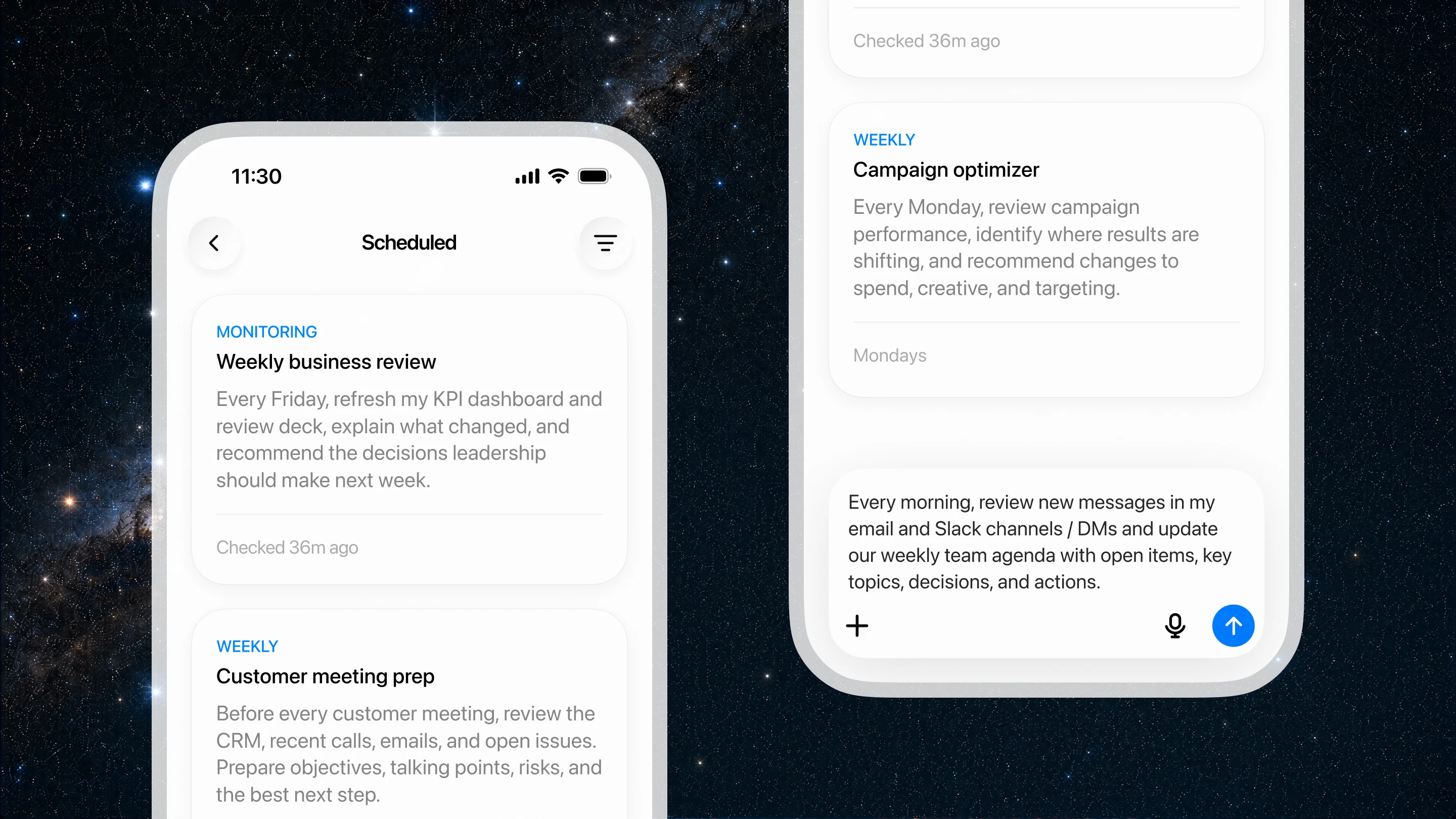
ChatGPT’s expanding product surface can be confusing: Chat, Work, and Codex sit alongside one another. Here I’m focusing on ChatGPT Work, which incorporates Codex technology to act across apps and files. Projects organize context, while assignments and scheduled tasks make ongoing work explicit. The relationship centers on one assistant, with the work more prominent than a persistent character.
This invites you to take on a similar role as Grok Bot, although with one agent. Your job is to commission and review work: describe an outcome, provide materials, and judge what comes back (e.g. a document, presentation, email draft). You start learning which context mattered and what should become a standing responsibility that can be set up as a routine.
The drawback of this approach is the prominence of the work, and how quickly it can feel scattered across different primitives. It is a struggle to pick up work unless you have cleanly organized your sidebar with pinned threads or Projects. But even then, the context may blur across these objects in a way that the single assistant easily offer to stitch together. For example, I ran into this when I started a thread in ChatGPT “chat” and needed to switch to ChatGPT Work to utilize computer use. It was my burden as the user to explicitly prompt the agent in a new mode to gather context and resume execution.
Claude Cowork: learning when to intervene with a single agent
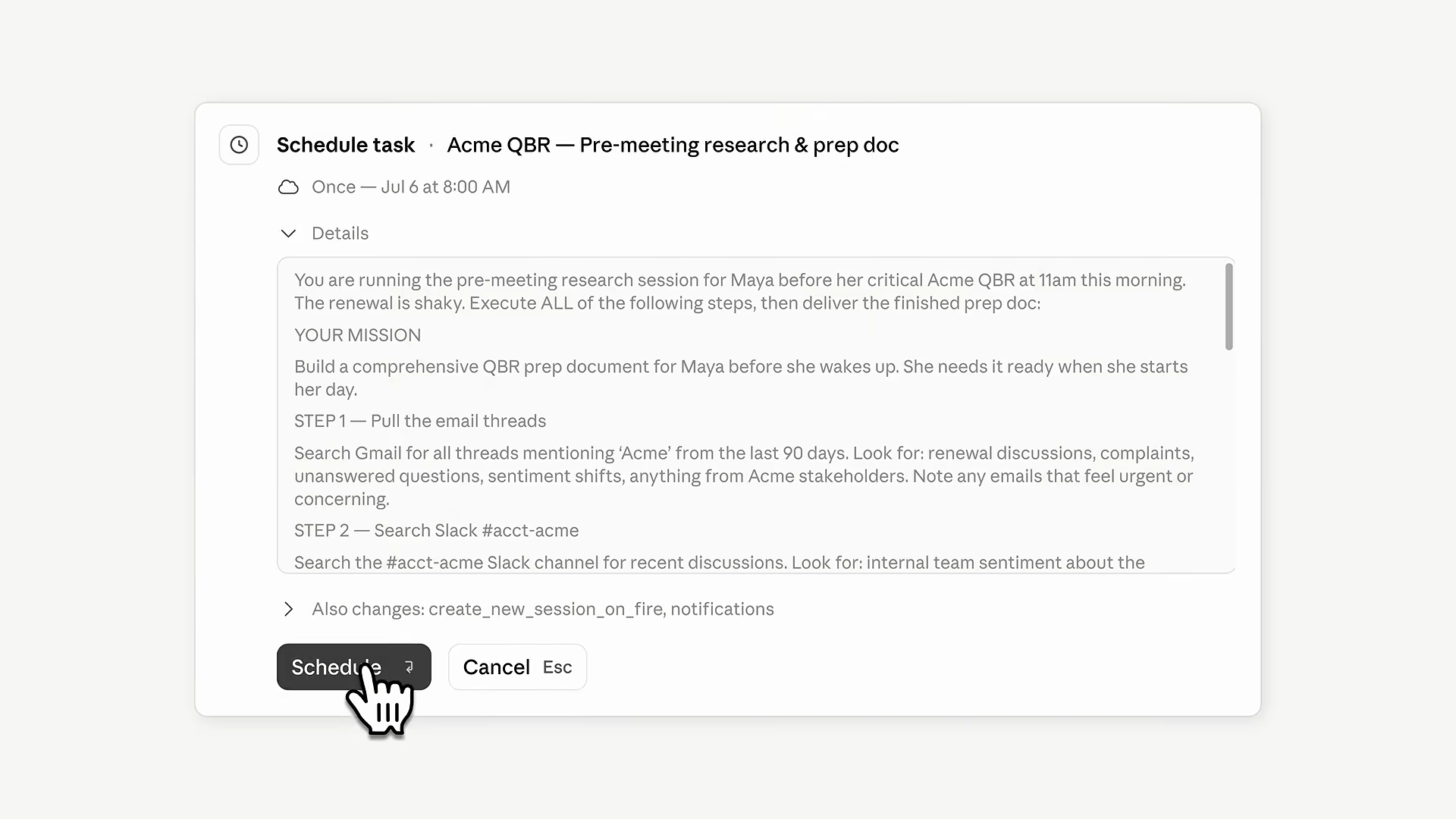
Claude Cowork offers a similar relationship with one assistant while making execution visible: selected files and tools, inspectable steps, and work that can run concurrently or on a schedule. More activity does not require a permanent roster of characters, placing it near ChatGPT Work on the map.
The interface invites an active reviewer’s role. You can follow how an assignment develops, notice where it diverges, and redirect it. That visibility can help you learn which parts of the work need your judgment and where a missing input is holding things up.
It can also encourage supervision simply because the steps are available to watch. The skill to develop is selective intervention: recognizing when examining the process will help and when reviewing the outcome is enough. Cowork’s visible execution is most useful if it helps you make that distinction over time.
Muse: learning to direct a single, familiar character
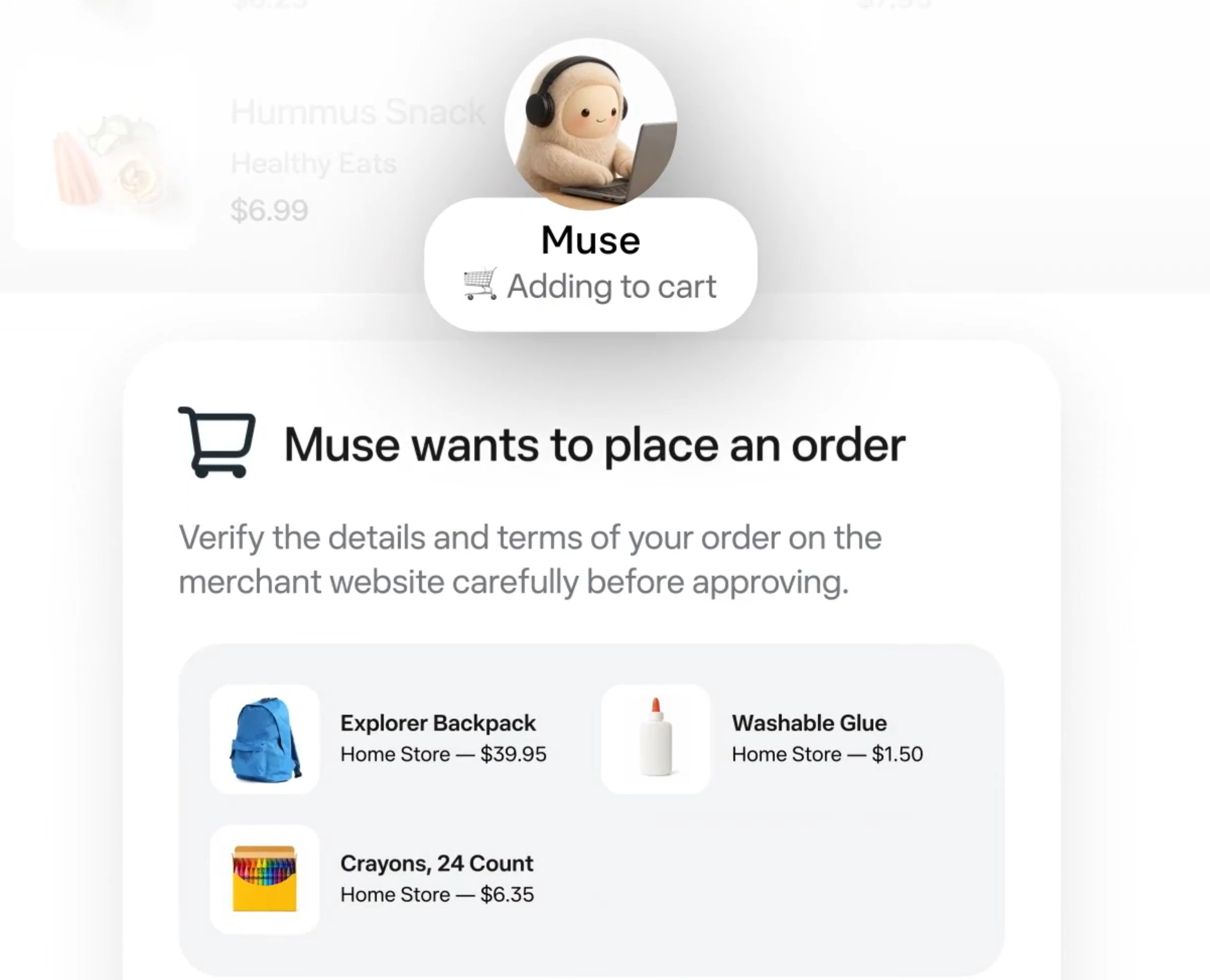
Muse offers a being-like relationship with one personal character. In How We Designed Muse, its designers describe choosing a customizable avatar, name, and personality because an ongoing conversation with a corporate identity felt wrong. Veda, their example, looks like a small knitted character. I read this as closer to a pet-like presence than a human employee: visibly artificial, but easy to develop familiarity and affection toward.
The relationship invites you to get to know the character; the practical role it can support is a collaborator who shares preferences and learns how to direct its capabilities. Current activity appears beneath the avatar, selecting it opens an activity log, and goals and editable memory give you concrete ways to shape the work. Those controls let familiarity develop into informed direction.
The potential blind spot is allowing attachment to soften your evaluation or create assumptions about emotional needs. The same Muse can remain a familiar presence while you become a demanding editor or an investigator of its mistakes.
Why familiar beings are a bridge
What I find interesting across these products is how much of the early experience depends on giving us a relationship we already know how to begin. A team of Bots invites us to assign responsibilities, a text conversation with Instinct makes it comfortable to share something before we’ve fully figured out what we need, and Muse gives us a character whose presence can become familiar over time. These decisions help us get past the initial uncertainty of interacting with software that can act on its own, especially while we’re still discovering what we want to hand over.
But the familiarity also brings assumptions that are worth examining. Human teams have stable roles partly because hiring is expensive, expertise takes time to develop, and knowledge moves imperfectly between people. Our relationships with pets involve affection, temperament, and care, which can influence how we respond to a character even when we know it is artificial. I think these are useful starting points, but I’m less convinced that we should organize our long-term relationship with agents around all the expectations that come with them.
The debate about whether one agent or many agents is better feels like an early expression of this uncertainty. There is something appealing about one assistant that knows your context and can carry a responsibility without making you decide who should handle each part of it. There are also situations where you might want to distinguish several contributors, understand what each is doing, and direct their work separately. My expectation is that we’ll want both, and that even our own preferences will change as we become more comfortable with what these systems can do.
That makes me hesitant to think of any one arrangement as the destination. A familiar relationship can help us discover a useful way of working, but we should also be able to recognize when we’ve started accommodating the metaphor instead of asking what the task actually needs. Becoming capable with agents will involve learning when to preserve that arrangement, when to change it, and when to take on a different role ourselves.
Role-playing is the meta-game
What interests me about these relationships is that we can commit to a role without treating it as the final definition of what we can do. I can learn to manage agents, take that responsibility seriously, and still remain open to discovering that a different approach would serve me better. The relationship can stay familiar while my participation changes: the same assistant I usually give assignments to might become something I think alongside, challenge as an editor, or work with to investigate a question I don’t yet know how to answer.
I think role-playing with agents becomes an important meta-game to master. We’re learning how to choose an approach, participate before we fully understand what is possible, and revise our role based on what happens. An individual task should still have a clear ending—the presentation needs to be finished, the reservation made—but completing it can leave us with a broader understanding of what we might attempt next time. And over time, that experience can change both how we use the agent and which responsibilities we feel capable of taking on ourselves.
I expect the people who become fluent with personal agents will learn to take a role seriously without assuming they have to remain in it. Sometimes we’ll want one familiar assistant that holds our context, and other times we’ll want several agents whose contributions we can distinguish and direct, with our preferences changing as we discover what each arrangement makes possible. Becoming capable will mean learning when to delegate, when to collaborate, and when to step back and question the approach we’ve taken. The strongest products will help us develop that judgment while leaving room for our roles and ambitions to grow beyond what the interface initially suggested. As more software operates beneath the surface, I hope the time and attention we recover will give us more freedom to pursue those possibilities, choosing where we want to participate and what we’re ready to leave in an agent’s hands.