Finding Rhythm in the Snow
My personal reflections on routines and adaptability, structure and motion
Last month, a Nor’easter dumped more than 18 inches of snow in our area. It was the kind of snow that makes everything look picturesque and maybe even briefly convinces you that wintertime in the Northeast might be magical.
Our mini bernedoodle, Gouda, was ecstatic. He tore through the backyard with a monumental case of the zoomies, bounding through powder that nearly swallowed him whole. For the first few hours, the snow was pure novelty. Pure joy.
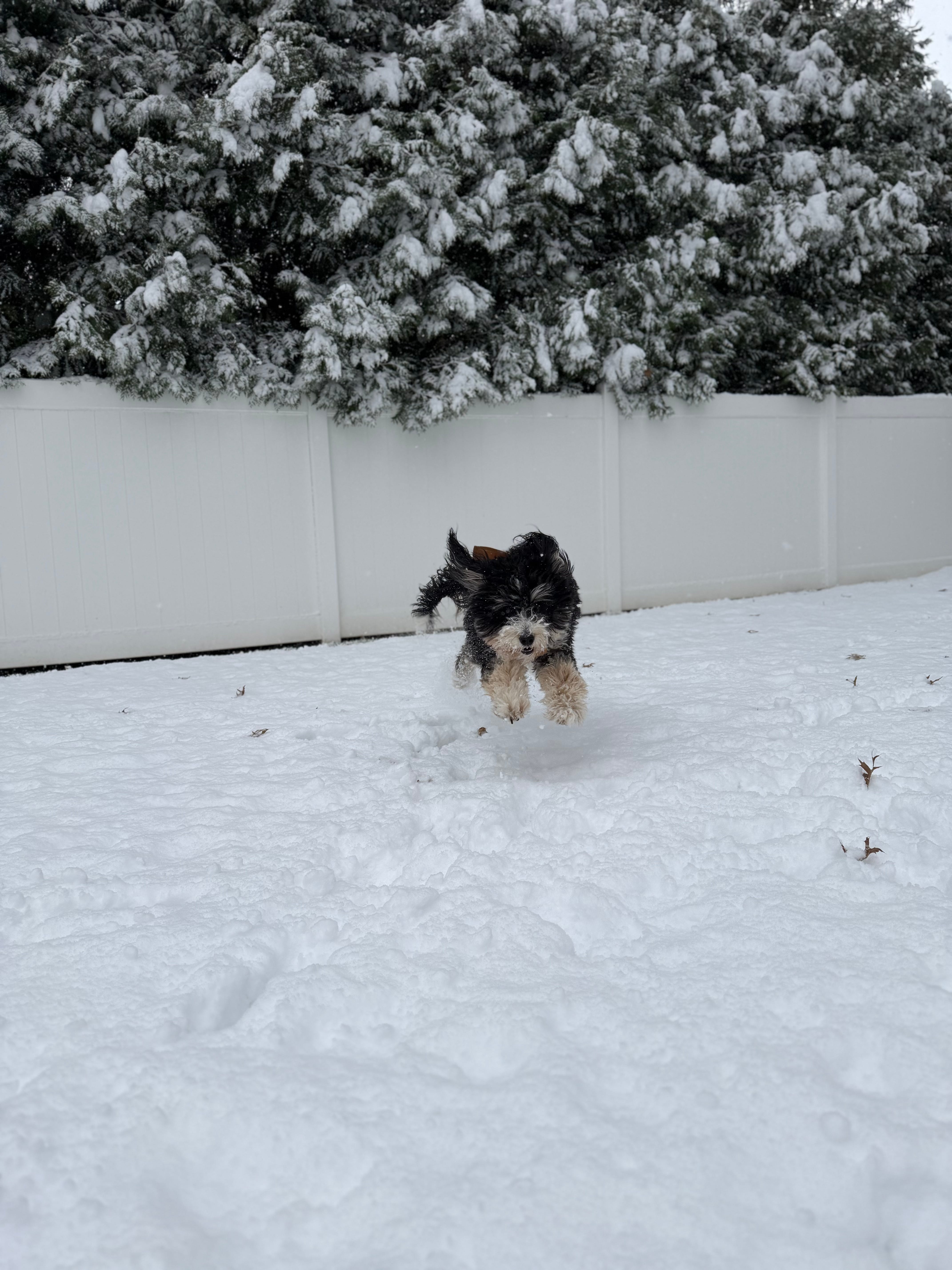
But as the day wore on, he slowly realized there was a problem.
Every morning at 8am, I take Gouda outside to begin his daily ritual. He walks to the same stretch of grass along the side of our house, sniffs it meticulously like a detective on the hunt, circles furiously, and does his business. It is quite unglamorous yet deeply consistent. Like clockwork, every single day.
Except now that patch of grass was gone. It disappeared under a thick white pile of snow.
They say dogs are creatures of routine. For that first day of snowfall, Gouda was genuinely unsettled. He sniffed and sniffed, but never went. Each time I took him out, he came back inside unresolved.
After 24 hours of silent suffering, we tried again the next morning. This time, I held the leash loose and let him show me the way. I followed him down the driveway, around the corner of our block, halfway up a neighbor’s snow-filled driveway. We clumsily waded through snow until he stopped suddenly, on top of a particularly pristine mound of fresh snow about a foot high.
He sniffed…circled…and then claimed a new spot. A new daily routine was born.
In the weeks since then, that mound of snow has become our daily destination. We walk the same arc. He leads, and I follow. A ritual restored, it just happens to be somewhere new.
He quickly found a way to relocate a sense of structure rather than abandon it altogether. Our morning ritual was still the same, we just needed to find a new patch — one that happened to be a little less convenient for me in freezing temperatures.
Watching him figure out a new routine connected to something about growth & adaptability that I’ve been working through myself.
The Missing Orientation
As a kid growing up in the suburbs, I first watched adulthood from the outside. I saw my parents’ life with certain rituals on repeat over and over and I had trouble digesting it. They worked incredibly hard and seemed happy with their lives. But to my younger mind, there was something about the daily repetition that felt suffocating. I couldn't imagine wanting to wake up and do something that looked so similar to what I'd done the day before, every single day.
I thought I wanted something different for myself, so early on — I craved motion. I wanted growth measured by change. I wanted to feel like my life was constantly expanding.
When it came time to apply to colleges, I decided I wanted to get the hell out of California. I dreamt of city life, ideally somewhere on the East Coast. In my head, I associated my own ambition with movement — physical movement, geographic change, proximity to energy. When the whole world is your oyster for opportunity, you think that means looking beyond your backyard (even though I ironically grew up in the heart of Silicon Valley).
So I left. I went to Philadelphia at first for my undergrad years. Then San Francisco, New York, Boston. And then back to New York. For over a decade in the formative years of my adult life, I ping-ponged between coastal cities — chasing rooms that felt bigger than the ones before.
I felt alive in the way that I had always imagined I would. I was busy. I was constantly meeting smart people chasing ambitious things. My mind was running with ideas and curiosity about the world. There was always something happening, a new opportunity or conversation that reminded me I was still becoming.
What I didn't have — and what I didn't think I needed at the time — was any real orientation. A fixed point to return to. I thought that was the whole point: to never stop moving, to never let things get too comfortable. But looking back, I can see that constant motion without any anchor also made it hard to know what I was actually building toward. I was covering a lot of ground without a clear sense of where I stood.
The Early Steps
At the beginning of my 30s, I noticed something subtly shifting. Even amidst all that movement, I started building pockets of consistency. I got into lifting regularly. I started going on long Sunday morning runs. My wife and I tried our best to stick with our homemade pizza making tradition for Sunday night football. We welcomed Gouda into our lives and he anchored the day with our sunrise walks to the East River.
I didn’t want to call these routines. That word still felt too loaded, too much like the thing I’d spent my whole adult life trying to avoid. I told myself they were habits — little rituals that gave me leverage as life got busier and more complicated.
But I can see now what was actually happening. I was finding rhythm. Not sameness — rhythm. Something that moves you forward rather than keeping you stuck in place. Surprisingly, these things weren’t constraints on my ambition. They were the infrastructure that let me actually direct it. Having something to return to gave me a base to push off from, and I started to feel the difference between motion that was reactive and motion that was intentional.
The Test of Adaptability
The biggest change came when we left city life and moved to the suburbs last summer. For the first time in my adult life, the external motion slowed way down.
If I'm honest, a big part of me worried that moving to the suburbs meant stepping into the pattern I had resisted for most of my life. Maybe this was the beginning of my own settling, or quietly shrinking the perimeter of my ambition without admitting it to myself. I struggled to adjust to my new life and my new identity, searching for routines that could give me some sense of normalcy in a place that still felt foreign. I wrote a little about how I navigated this period of change.
And then at the start of this year, our daughter was born. So began the next chapter of navigating change. While my wife and I are having fun as first-time parents, it’s a constant education in adaptability.
What worked yesterday might not work today. A rhythm briefly appears, dissolves, and then somehow re-forms. You can’t cling too tightly to anything without feeling frustrated and exhausted. What I’m slowly learning about adaptability is that it helps you reshape structure when the ground shifts underneath you. The orientation stays, and the rhythm can come back. You just have to be willing to find them somewhere new, just as Gouda waded through the snow until he found a new spot.
The Real Truth about Growth
I used to think that a life of routine would be the death of growth. Somewhere along the way, through the city-hopping and the constant pursuit of the next thing, I had convinced myself that structure and ambition were in tension with each other. But sitting here now — I think I've landed somewhere different.
Growth needs all three things working together: orientation, so you have somewhere solid to stand; rhythm, so you keep moving forward; and adaptability, so when the ground shifts — and it always shifts — you can relocate the whole structure rather than abandon it. For a long time I was strong on one of these and missing the others. The city years gave me a lot of movement but not much to stand on. The habits I built in my 30s started giving me rhythm. And everything that's happened in the last year has been a crash course in adaptability.
What's surprised me most is that having all three working together is making my life feel sharper and more focused. I know more clearly what I want to prioritize: being present with my daughter and wife every day, taking care of my physical health, building things at the intersection of AI and human creativity, and staying close to people who are curious and ambitious about the world. The structure is giving me more energy to direct toward the things that actually matter to me, and a way to be more intentional in how I spend my time.
Yesterday morning, I took Gouda out like I always do. The snow had finally melted, and instead of our usual neighborhood trek — he made a beeline straight to his old patch of grass. He sniffed briefly, circled, and returned to his original routine like nothing had ever happened.
The patch was always there. But now he knows he can always find a new one.