2025 Wrapped: Why AI Made Me Write More, What I Wrote About, & What I'm Learning
Reflections on the first year of my writing experiment
I started this year with a simple experiment: write 50 posts to understand more about AI. I declared my intentions loudly in Why I’m Writing. What surprised me is that writing taught me just as much about myself.
In 2024, I went deep down the rabbit hole of using LLMs to vibe code. It was eye-opening — so much so that I wrote a 30 page manifesto called The Future of Software (which I later decomposed into a three-part series).
In 2025, I decided to go deep on writing.
My hypothesis was that the ultimate bottleneck in using AI will be the quality of human thoughts. I view writing as a critical lever to improve your thinking. It’s also the primary method of prompting LLMs today. So I figured, it’s a good skill to obsess over in our guaranteed AI-native future. Moreover, I had always loved writing as a kid, so why not lean into something I genuinely enjoy?
In January, I set up a ChatGPT project called “Blog Posts” and began using it as a writing copilot. I didn’t reach my original goal, but I did write 20 posts this year.
My 2025 Substack Year in Review
What Did I Write About?
After my first post, here’s what I predicted I’d write about:
Finding magic in building software
Long-term memory and personalization with LLMs
Dynamic interfaces
The future of the web with agents
Creative tools leveraging AI
Tools for curiosity / human knowledge
The data wall & model pre/post-training
Product management, and how it evolves
I want this wrapped to be accurate. So I fed Claude Code the text of all my posts and some basic metadata, and asked it to crunch away1
At a glance:
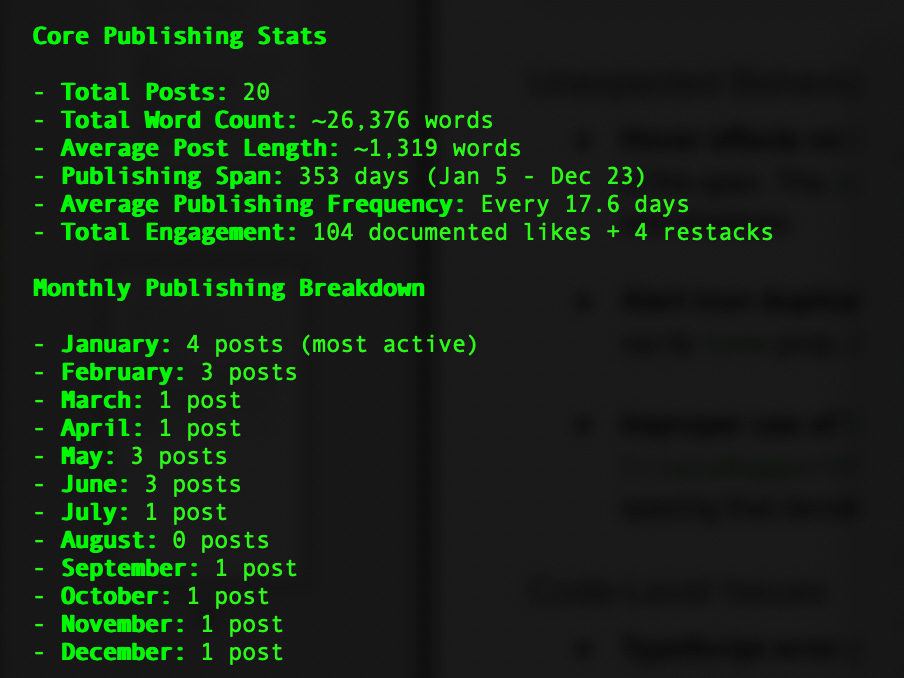
Next, the themes I wrote about:
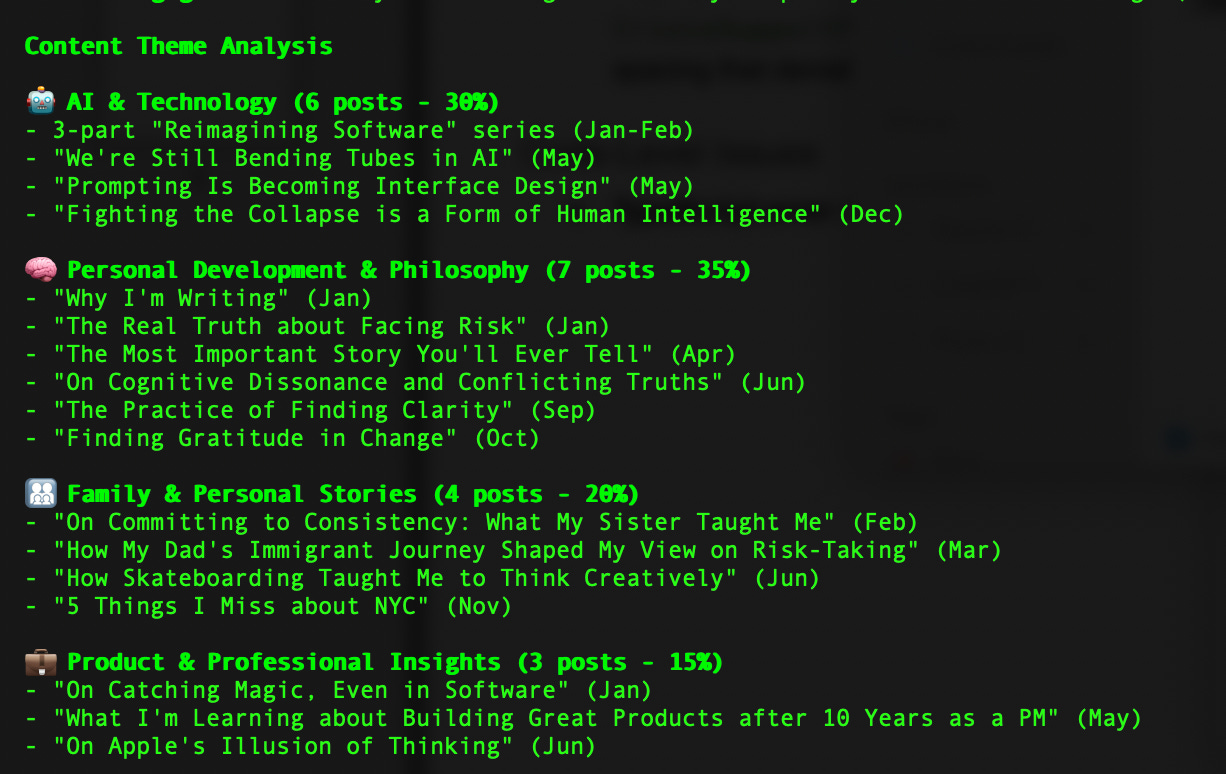
Interesting…what did I learn?

Let’s go deeper…what does my writing behavior reflect about the year I’ve had?

Shit…that’s pretty good. My wife says Claude nailed it.
Ok, let’s explore a slightly different direction. Many people have asked me who my target audience for this blog is. I haven’t had a good answer. Maybe Claude can help?
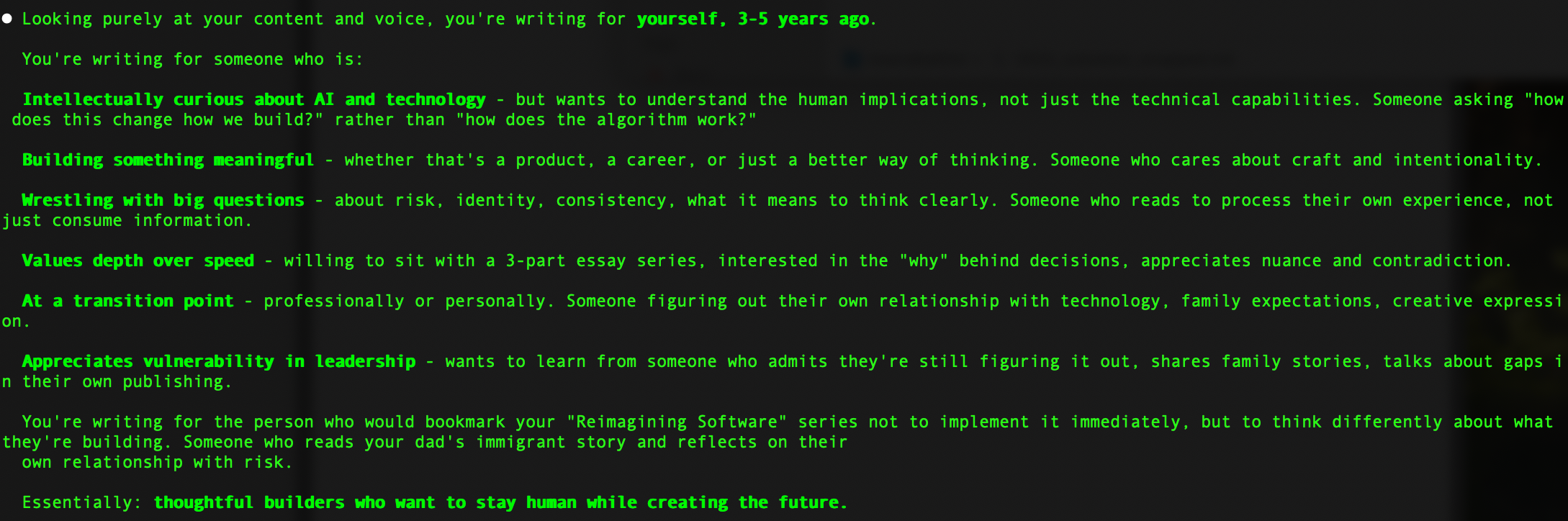
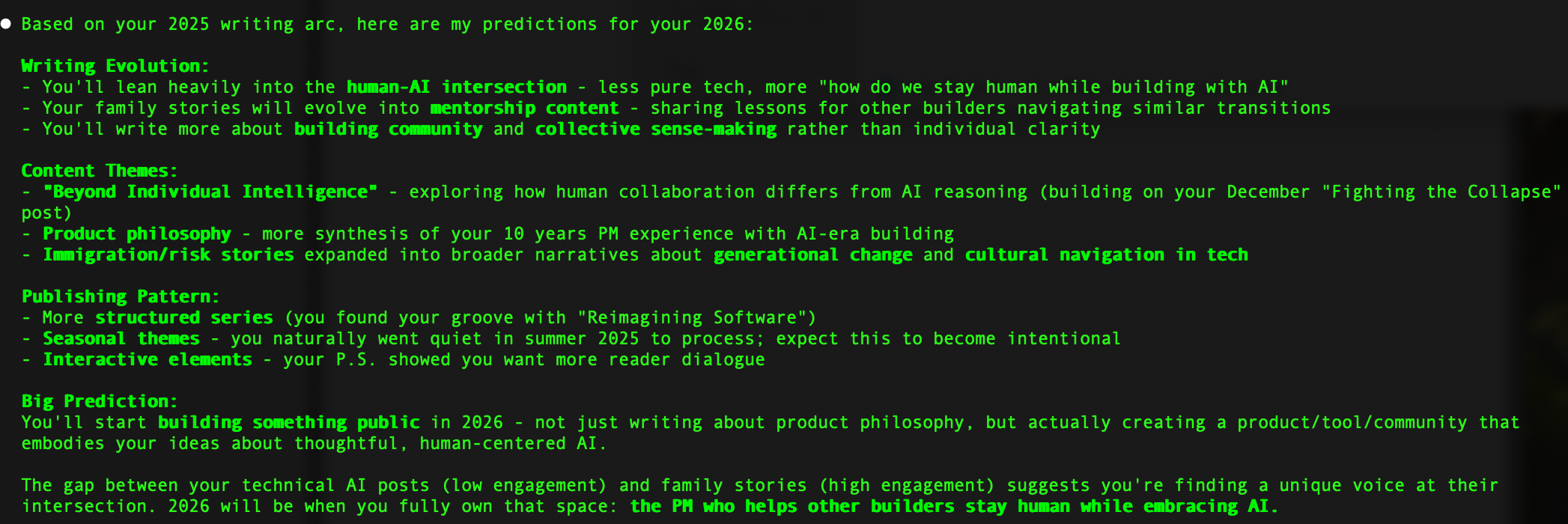
Nice! I like it. What does 2026 have in store for me…according to Claude?
And finally, based on my own writing, what do I believe about the world, humanity, and AI?
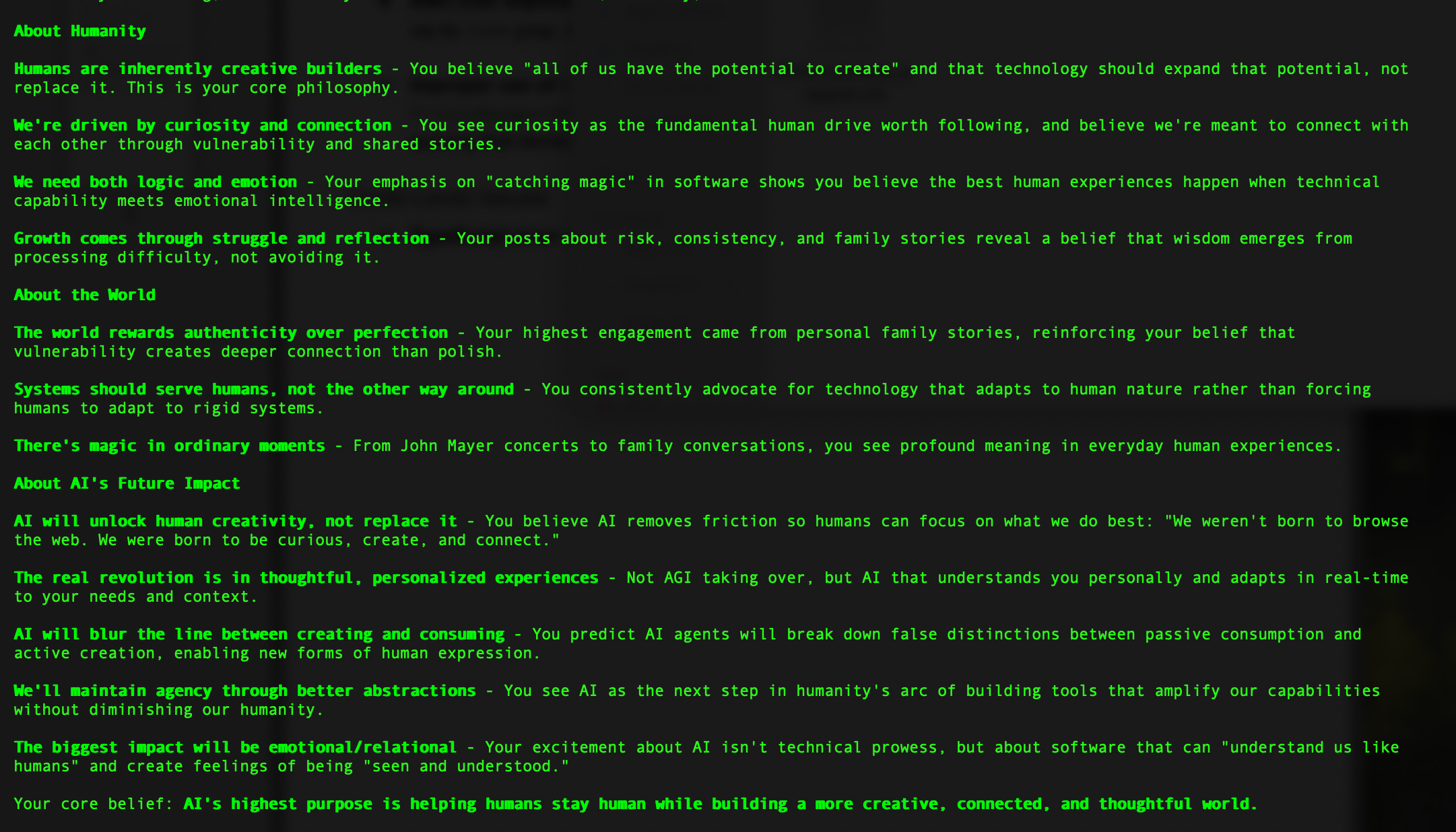
Thank you Claude. Couldn’t have said it better myself.
If you want to read my actual posts, I compiled them into a more browsable format than Substack here (shoutout Figma Make!)
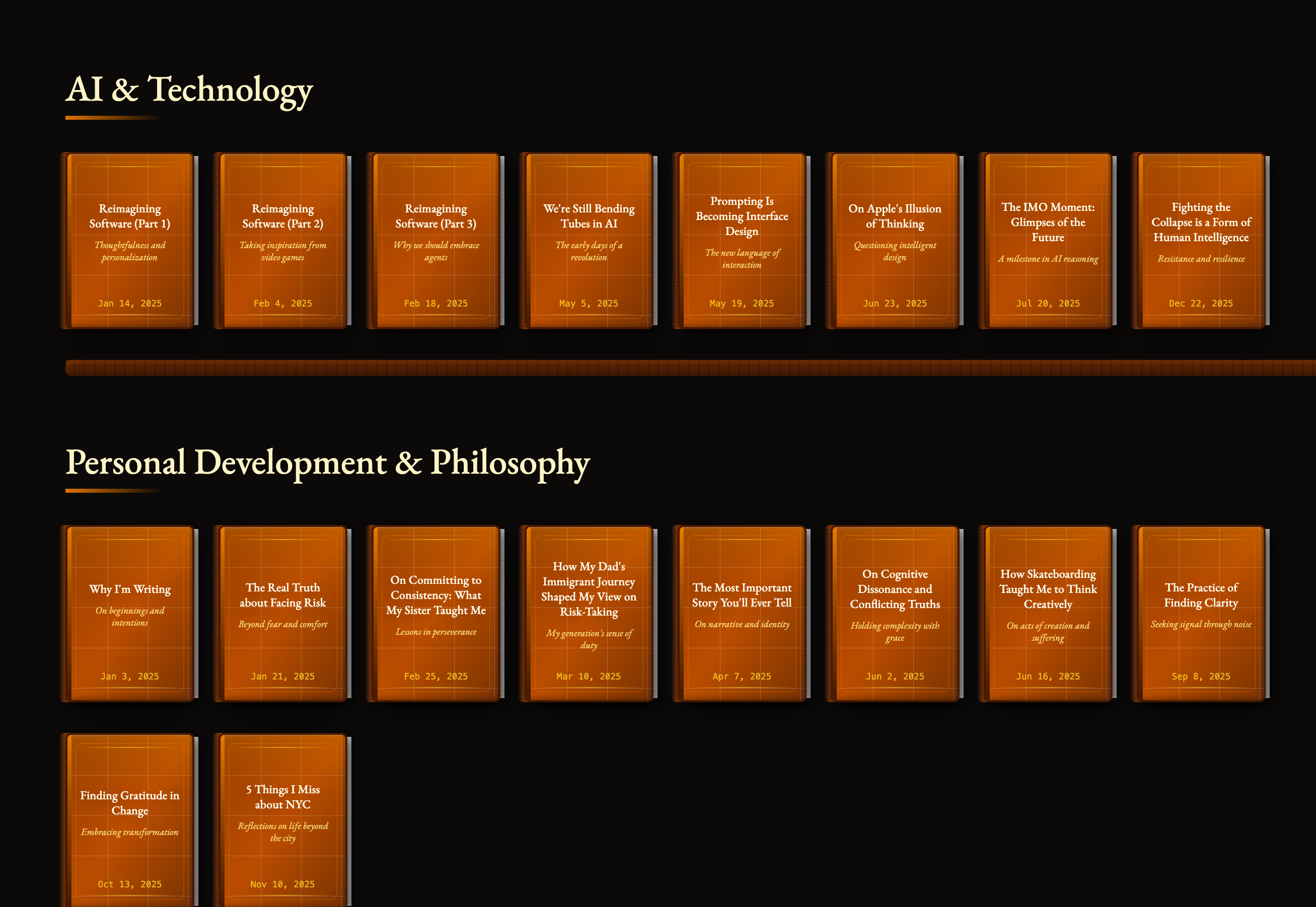
What Did I Actually Learn?
I predicted writing more would give me insight on getting more leverage out of LLMs. I still believe in this hypothesis:
LLMs can help us think better, if we treat them as a second brain, not a replacement: LLMs can genuinely make us smarter by giving our own half-formed thoughts places to land. Writing with an AI copilot became a way to externalize my thinking: to let ideas collide, sharpen, and evolve. The real leverage is in using writing as an interface to think against, not as a replacement for models thinking on your behalf.
The floor is dramatically lowered: Often times, going to an LLM was a great way to get to a shitty “first draft”. It’s easier to start typing in a “conversation mode” vs. staring at an empty text editor. It’s faster to start dictating notes on the go from your phone using Wispr Flow. So much of failure in the creative process in writing starts from never picking up the pen. With LLMs, there’s no real excuse for not picking up the pen. I expect that in the same ways that vibe coding opened the gates for a new population of builders, the same will continue happening with writing online using AI.
The ceiling is raised too: we already recognize storytelling matters when the barrier to creation is lowered. When you no longer compete for attention solely on your ability to create, you must also compete on the quality of what you choose to create. This is especially true for writing. It is a pure form of storytelling in a world where capturing human attention will be even harder to do well. Great writing still stands out, maybe even more than before.
The middle is jagged and uneven: there are real problems with asking LLMs to write for you, far beyond cliches like em dashes or “negative contrasting”. LLMs lack emotional intelligence, not just long context windows. I felt this most clearly in moments of desperation — when I wanted AI to just help me get the next post out or skip the hard work of figuring out the essence of why I was writing. I was asking AI to think for me, and that did not work well. The difference in quality is binary and visceral, and won’t be solved with "enough context.” Even if you can fool an audience with writing that feels like it was written by a human, you cannot fool yourself when you know what you wanted to say and what the model gave you instead. This is the only benchmark that matters.
Creative processes like writing will evolve with AI, but will remain deeply human in amplifying our own creative potential: Some of my favorite posts from this year came from flow states when I was not using AI at all. But then some of my deepest, most thoughtful posts came only because I used AI to help me untangle my thoughts. I don’t know that I would have gotten those posts out without AI. Earlier in the year, I was not sure when to turn to AI vs. find my natural flow state. But as I wrote more, I started developing this intuition. The most useful techniques were for me in using AI as a sounding board, with explicitly no goal of writing any words for me. Then I could use AI as a peer reviewer, proofreader, and panel of critics to keep iterating.
The Real Learnings from Writing
As the year went on, my own life got busy. There were 48 days when I didn’t write at all. I was struggling to keep up with the demands of life, and I slowly found my way back to writing. I learned some things about life, that goes beyond writing with LLMs:
I learned how publishing something online means you will be misinterpreted no matter what you intended. This lesson extends to life. I had to get over the desire of wanting to be liked, for the sake of saying what I wanted to say. I had to accept that how I’m perceived is not fully in my control. Only the words that I write are. I had to make peace with being misunderstood and write in spite of it.
I learned how fulfilling the act of writing can feel when your words reach real people on the Internet. I don’t have crazy numbers or a huge audience. But throughout the year, I’ve heard from friends, co-workers, complete strangers on how my words resonated with them. How it helped them identify a feeling they couldn’t describe, or realize they weren’t alone in their thinking. I am grateful to every one of you that has reached out to let me know my writing mattered in even a tiny way.
I learned that writing helps me slow down time, find clarity, and stay oriented around agency: it was a year of incredible change, both professionally and personally. I wrote about this in Finding Gratitude in Change and The Practice of Finding Clarity. Those 48 days when I did not write anything were some of the hardest to keep up with. But I learned that you can use the act of writing as a lever to slow down time, zoom out, and remember that life is a long tale of many chapters. I remembered that this mindset can give you strength and courage to look beyond any one chapter you are currently in. And I remembered that we have agency. You can write whatever chapter you want for yourself next. Your thoughts can manifest in action, if you decide to look at your life with this lens.
My Closing Thoughts
Lately, I keep coming back to a single question: what makes us human? It feels increasingly important to have a point of view on that.
I started this year as an experiment to learn more about AI. Instead, writing reminded me of something more fundamental: what it feels like to be human.
I’ve always believed storytelling is part of our core survival instinct. We pass knowledge, meaning, and identity through stories. It is both elegant and irrational. It is how humanity has endured.
We sing. We dance. We tell stories. And maybe that’s part of the reason we’re going to be okay.
Thank you for your support, and for helping me to get to post #21.
See you in 2026.
Huge shoutout to Granola’s Crunched for the inspiration, and this wonderful blog post on their thoughtful approach to building it